

Where the Vine Looks Out to Sea
Continuing eastward, Liguria changes once again.
The valleys of the far western Riviera gradually give way to a landscape of bays, headlands and small villages gathered around the sea.
This is theGulf of Tigullio.
From Genoa towards Portofino, Rapallo, Santa Margherita Ligure, Chiavari and Sestri Levante, the coastline unfolds through a succession of coves and inlets, while just behind it the hills rise quickly from the sea.
And a little further east, this same encounter between mountain and Mediterranean becomes even more extreme.
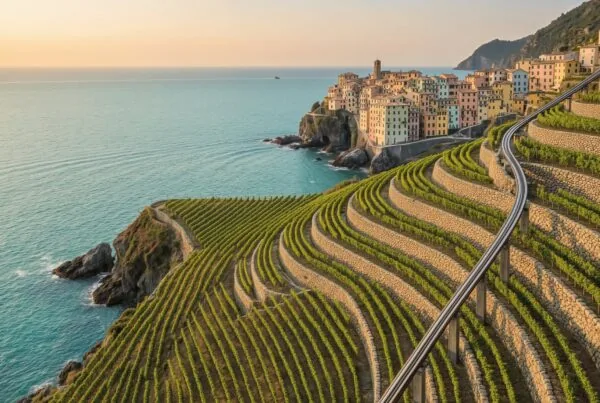
These are theCinque Terre, where we have already seen vines clinging to terraces suspended above the sea.
In some ways, the Tigullio anticipates that landscape, but with a different character.
Here, the mountains seem to take a step back.
Bays and headlands appear, together with olive groves and small cultivated plots hidden between the villages.
It is along this narrow boundary between land and Mediterranean that theGolfo del Tigullio–Portofino DOCis born.
Here, vines do not cover vast expanses of land.
They appear.
Disappear.
Then emerge again among olive trees, woodland, houses and small plots carved into the hillsides.
Viticulture here is fragmented, shaped over generations and often confined to pieces of land that elsewhere might seem too small ever to become vineyards.
But in Liguria, we have learned something by now.
Land is not measured only in hectares.
It is measured by the ability to preserve it.
The sea is a constant presence in this landscape.
It moderates the climate, carries breezes along the slopes and fills the coastal hills with light.
The wines born here reflect the same character.
They are often fresh, delicate and immediate in their aromas, deeply connected to the cuisine and everyday life of the territory.
They do not need to express greatness through power.
They tell us something else.
Closeness.
Between the vineyard and the sea.
Between wine and the table.
Between a territory and the people who continue to call it home.
There are places where vineyards dominate the landscape.
Here, instead, you have to look for them.
And perhaps that is precisely what makes them so precious.
BIANCHETTA GENOVESE
Liguria’s Hidden White Grape
Some grape varieties are known throughout the world.
And then there are others that seem to belong almost entirely to the place that has preserved them.
Bianchetta Genoveseis one of them.
Its name is rarely heard outside Liguria.
It did not build its reputation through large production or international markets.
Instead, it remained here, between Genoa and eastern Liguria, tied to the hills and the rural traditions of the territory.
For centuries, it was simply part of the landscape.
But what exactly is Bianchetta Genovese?
It is an ancient white grape variety from Liguria, historically cultivated mainly around Genoa and in the eastern part of the region, where it also finds a home within the Golfo del Tigullio–Portofino DOC.
Its name already tells us something about its nature.
“Bianchetta” recalls the pale colour of the grapes and perhaps also the simplicity with which this wine has been enjoyed for generations.
Not as a symbol to be displayed.
As a wine to be drunk.
In the glass, it tends to express itself with discretion.
White flowers.
Delicate fruit.
Herbs.
A clear freshness that carries the wine without weighing it down.
This is not a grape built around opulence.
It is subtle.
Direct.
Almost quiet.
And that is precisely what makes it interesting.
Because understanding Italian wine also means looking beyond the most famous names.
It means discovering those varieties that survived because someone, generation after generation, simply continued to grow them.
Bianchetta Genovese tells the story of this Italy.
The Italy of grapes that never conquered the world.
But never left home.
BETWEEN GENOA AND PORTOFINO
The Vineyard You Have to Look For
When we imagine a vineyard, we often picture orderly rows of vines stretching towards the horizon.
Here, it is almost the opposite.
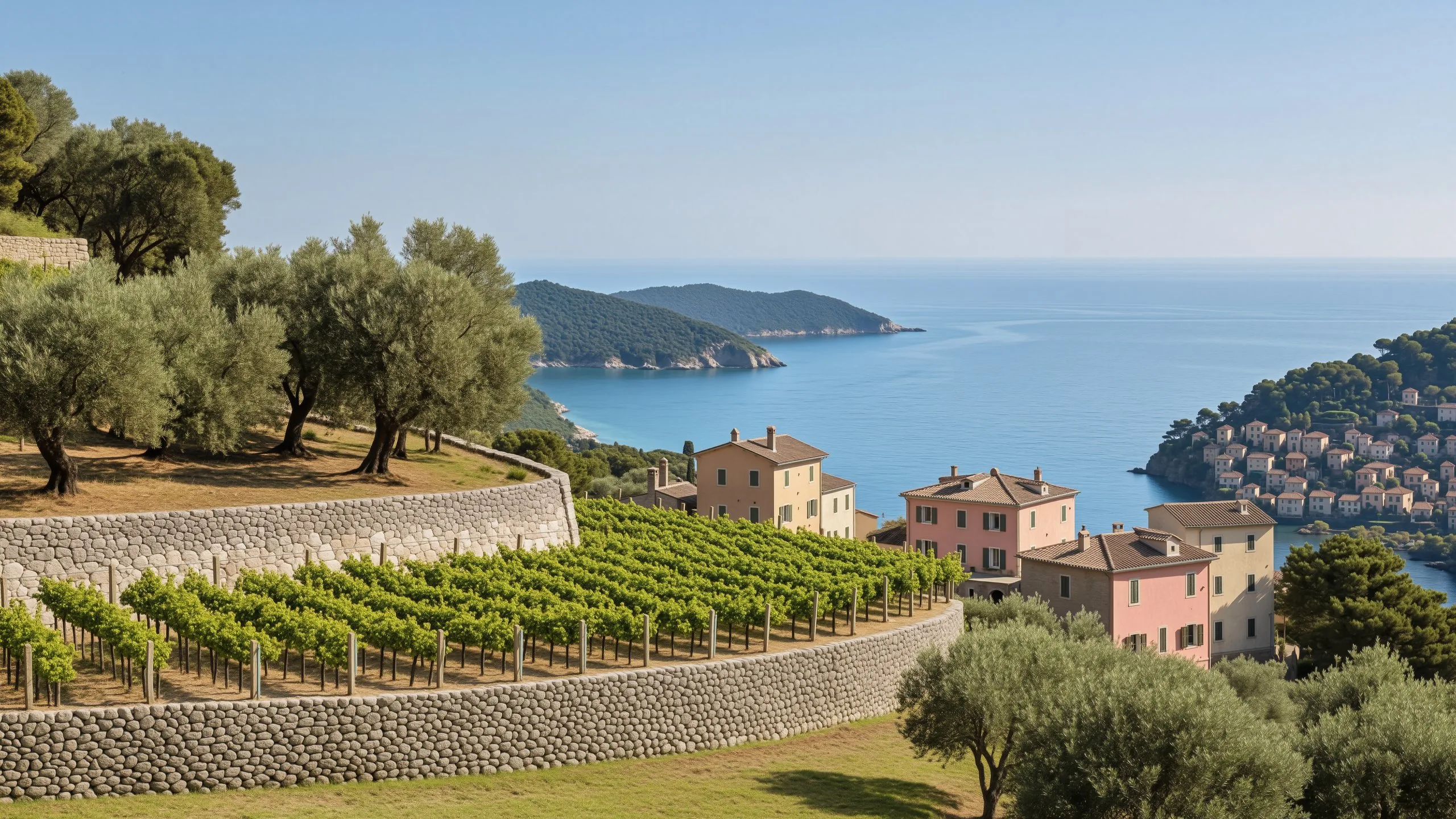
Between Genoa and the Gulf of Tigullio, vines must share the land with everything that makes this landscape so distinctive.
Olive trees.
Woodland.
Houses.
Stone walls.
Narrow roads.
And, of course, the sea.
That is why vineyards can appear without warning.
A small plot above a village.
A few rows of vines along a hillside.
A terrace hidden behind a stone wall.
Then nothing again.
This is a viticulture made of fragments.
And every fragment tells the same story.
The story of a region where cultivating the land means, first of all, finding space.
The steep slopes make the work difficult.
Mechanisation is often limited.
Many tasks must be carried out directly by hand.
Yet these small vineyards continue to exist.
Not because they are the easiest way to produce wine.
Quite the opposite.
They exist because they are part of the landscape and the memory of the people who live here.
And perhaps this is the most beautiful image to carry with us as we leave the Tigullio behind.
A vineyard that is almost invisible.
A few rows of vines among the olive trees.
And behind them, the Mediterranean.
As we continue further east, however, something slowly begins to change.
The hills begin to open.
Tuscany draws closer.
And Vermentino finds a new land in which to tell its story.