

Where the Alps Meet the Mediterranean
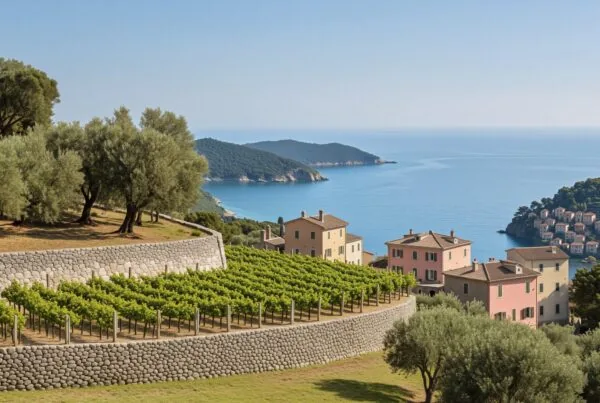
At the far western edge of Liguria, almost on the border with France, the Mediterranean suddenly seems to draw closer to the mountains.
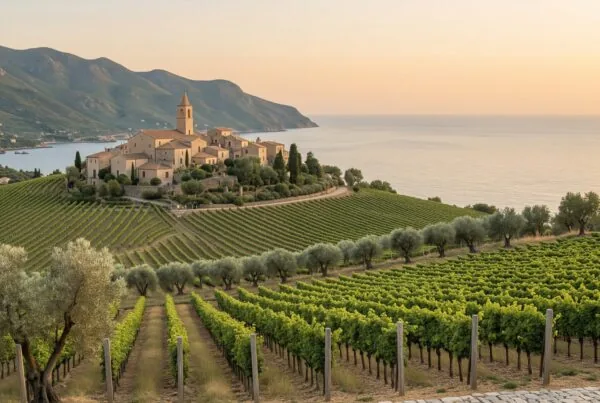
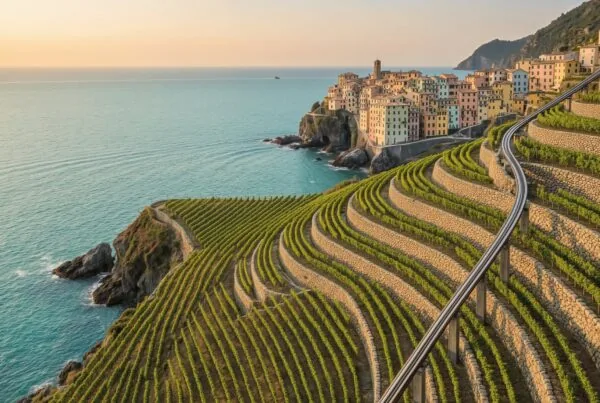
Within just a few kilometres, the coast gives way to narrow valleys, stone villages and steep slopes, where vines occupy the small spaces that generations of people have managed to carve from the mountains.
This is whereRossese di Dolceacquais born.
A red wine in a land we have come to know primarily through its whites.
And it is precisely this difference that makes it so fascinating.
But what exactly is Rossese di Dolceacqua?
It is the signature wine of Liguria’s far western edge, produced primarily from the Rossese grape in a small territory centred around the valleys descending from the Alps towards the sea.
Dolceacqua lies at its heart.
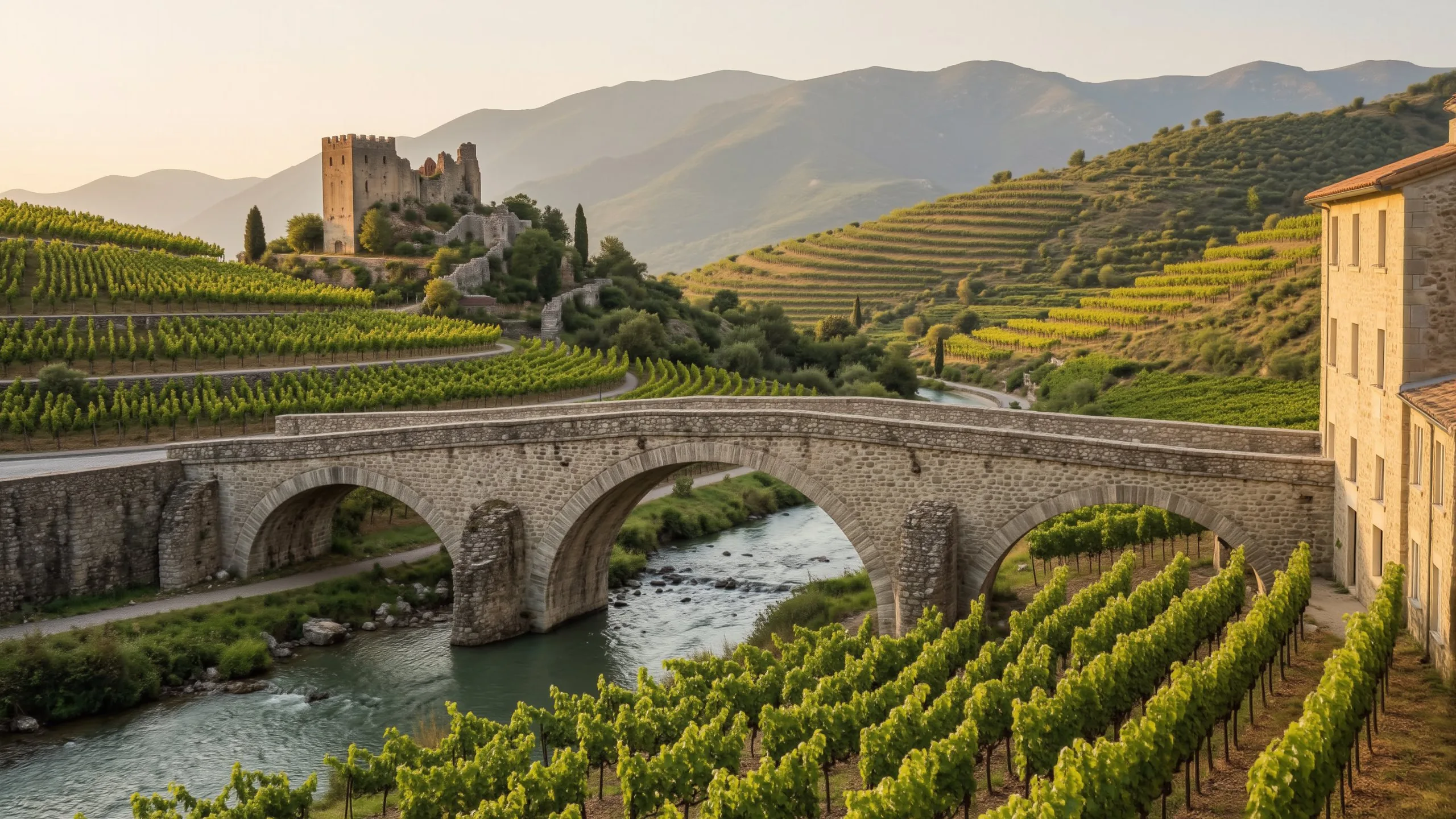
A small village crossed by the Nervia stream, watched over by the Doria Castle and connected by the famous medieval bridge that Claude Monet would later transform into the subject of his paintings.
Around it, the landscape changes quickly.
Vines grow along the slopes.
Vineyards follow the contours of the mountains.
The Mediterranean remains close, yet the air of the Alps can already be felt.
It is from the meeting of these two worlds that Rossese di Dolceacqua finds its identity.
In the glass, we do not find the power so often associated with Italy’s great red wines.
The colour can be delicate.
The body elegant.
Its aromas recall small red berries, flowers, spices and Mediterranean herbs.
Yet behind this apparent lightness lies a wine capable of expressing its territory with extraordinary precision.
Because not every great wine needs strength.
Some need only a voice of their own.
And the voice of Rossese comes from a place where the mountains can still look out towards the sea.
ROSSESE
The Strength of Delicacy
Some grape varieties win us over through power.
Others ask to be listened to.
Rossesebelongs to the second category.
Its naturally pale colour might suggest a simple wine.
But that would be a mistake.
Behind that transparency lies one of Liguria’s most fascinating grape varieties.
Rossese thrives on the well-exposed slopes of the western Ligurian hinterland, where the Mediterranean climate meets the cooler currents descending from the mountains.
Here, it develops a subtle character that is deeply rooted in its territory.
In the glass, small red berries, violets, aromatic herbs and spices emerge.
At times, there is an almost wild note.
The structure remains graceful.
The tannins are present without ever becoming the protagonist.
Freshness carries the wine forward, giving it energy and elegance.
It is a wine that teaches us something important.
Intensity is not measured by weight alone.
It can exist in the precision of an aroma.
In the tension of a sip.
In the ability to leave a memory without ever raising its voice.
Rossese does not try to become another great Italian red.
Its strength lies in precisely the opposite.
In being profoundly Ligurian.
THE WINE OF NAPOLEON
When History Becomes Legend
Every great wine region preserves at least one story that time has transformed into legend.
In Dolceacqua, that story bears the name ofNapoleon Bonaparte.
According to a tradition passed down through generations in the area, during the Italian campaign the future emperor is said to have tasted the wine produced in these valleys and to have been so impressed that he wanted it to bear his own name.
It is a fascinating story.
But, as so often happens when wine and history meet, the line between documented fact and legend becomes blurred.
There is not enough evidence to present the episode as historical certainty.
And perhaps there does not need to be.
Because wine legends can tell us something that dates alone cannot always explain.
They tell us about the relationship between a community and its wine.
About the way a bottle becomes part of the memory of a place.
Rossese has accompanied these valleys for centuries.
It has been the wine of families, of vineyards carved into the slopes, of small inland villages and Ligurian tables.
Napoleon may have tasted it.
He may have admired it.
The rest belongs to the story that Dolceacqua has chosen to pass down through generations.
And perhaps this is precisely the fascination of great legends.
They do not necessarily need to explain a wine.
They help us understand just how important that wine has become to the place that created it.
From here, continuing eastward, Liguria changes once again.
Red gives way to white.
And among the sea, the hills and ancient villages, another story begins.