

The other voice of Nebbiolo
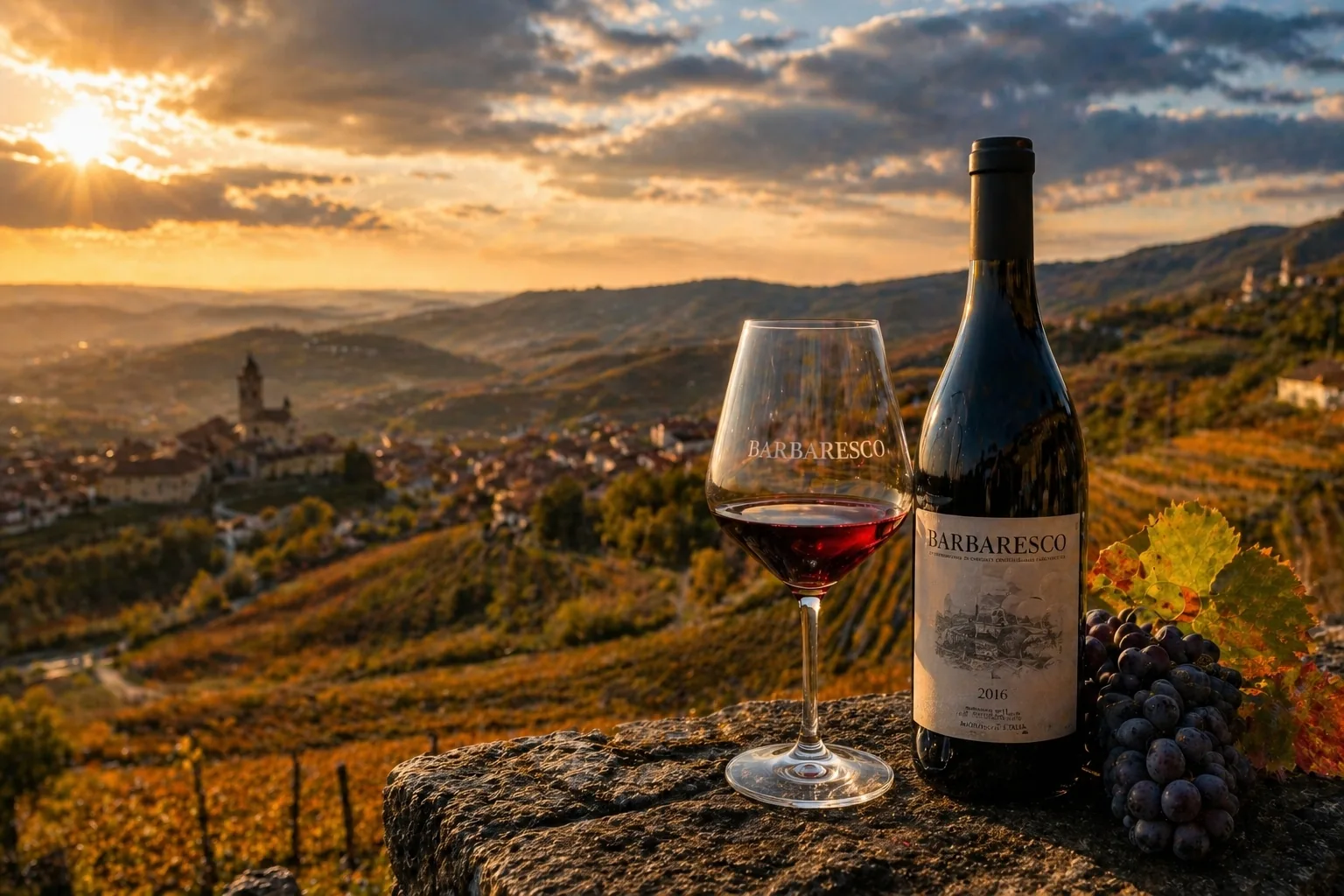
AfterBarolo, Piedmont does not fall silent. It changes tone. If Barolo is a solemn declaration,Barbarescois an ongoing conversation. It is born just a few kilometres away, from the same demanding grape variety, on the same Langhe hills. And yet it tells a different story.
HereNebbiologrows around three main villages,Barbaresco, Neive and Treiso, with a small portion of the territory of Alba. The landscape is more compact, exposures more continuous, the climate slightly milder thanks to the proximity of the Tanaro River. These are details that are not immediately visible, but that the wine expresses with precision.
Barbarescodoes not give up depth, but builds it differently. Less muscular, more continuous. It is a wine that works through progression rather than impact, through clarity rather than monumentality. It does not ask for silence. It asks for attention.
It is aNebbiolothat does not lose rigour, but chooses measure. And within this sense of balance, in the heart of the Langhe, one of the most important revolutions in modern Italian wine also begins to take shape.
Gaja
When the producer becomes the territory
In a Piedmont built on respect for rules, on the identity of appellations and the strength of the disciplinare, something begins to shift. Not in the land. In the way it is seen.
This is where AngeloGajaenters the story.
He does not break the system. He questions it.
He does not reject tradition. He observes it from the outside.
Starting fromBarbaresco,Gajaintroduces a new idea for his time: the producer is not only the one who follows rules. He is the one who interprets a place.
He works the vineyards differently. He selects parcels, distinguishes hillsides, gives value to specific portions of land. He develops a concept that today feels obvious, but was not at the time: the cru.
In the cellar, the choices follow the same direction. Lower yields, greater precision, the introduction of smaller oak barrels. Not to change the wine, but to control its expression more closely.
The result divides opinion.
Some see a break from tradition.
Others recognise that something necessary is happening.
Gajadoes not only change his wines. He changes the way Italian wine is understood. He shifts the centre of the conversation: from the disciplinare to the producer.
Super Piemontesi
When the rules become too narrow
At a certain point, the system is no longer enough.
Some ofGaja’s most iconic wines move outside the boundaries of the appellation. Not because they lose their connection to the land, but because they choose to go beyond the limits imposed by the disciplinare.
The addition of small percentages of other varieties, such as Barbera or Cabernet, is enough to loseDOCGstatus. And so wines born inBarbarescoformally stop being Barbaresco.
They become Langhe.
On paper, it looks like a step backwards.
In reality, it is a shift in perspective.
An idea emerges that echoes what had already happened in Tuscany with the Super Tuscans. Wines that do not fit within the rules, yet do not lose identity. In fact, they strengthen it.
“Super Piemontesi” is not an official category. It is a way of reading a moment in Italian wine. A moment when territory alone is no longer enough to define a wine, and the vision of the producer becomes essential.
Modernity as a choice
To speak of Gaja is to speak of change. But not in a superficial sense.
Here, modernity means control.
It means awareness.
It means choice.
Reducing yields means deciding what remains on the vine and what does not. Using smaller oak means managing evolution more precisely. Working with crus means accepting that territory is not uniform.
These are decisions that today seem natural. But at the time they represented a rupture.
Gajadoes not erase tradition. He refines it.
He does not abandon the land. He interprets it.
And above all, he introduces a fundamental idea:
wine is not only the result of a place.
It is the result of a way of seeing that place.
Barbaresco and Barolo
Time, discipline and two ways of interpreting Nebbiolo
BarbarescoandBaroloshare the same grape, but not the same rhythm. Both are made from pureNebbiolo, both are wines of structure and longevity, both express the deepest identity of Piedmont. But they do so with a different sense of time.
TheBarbarescodisciplinare requires a minimum ageing of 26 months, including at least 9 months in wood. The Riserva extends to 50 months.Barolorequires longer ageing: at least 38 months, with 18 in wood, up to 62 months for Riserva.
This is not a difference in value. It is a difference in pace.
Barolobuilds through accumulation.
Barbarescoworks through continuity.
They are two different ways of inhabitingNebbiolo. Two different ways of living time.
Barbaresco at first encounter
When Nebbiolo becomes listening
The first encounter withBarbarescois never loud. In the glass, the colour is pale, transparent. It does not promise power. It invites you closer.
The aromas arrive in order. Flowers, fruit, a trace of earth. Nothing overwhelms. Everything speaks.
On the palate, the tannin is present but never gripping. Acidity supports without tightening. The wine flows, extends, remains.
It does not challenge. It asks for attention.
For those encounteringNebbiolofor the first time,Barbarescois a natural threshold. Not because it is simple, but because it is readable.
It is a wine that does not impose. It accompanies.