

Barolo: A Landscape That Becomes Time
The Langhe and the Discipline of Place
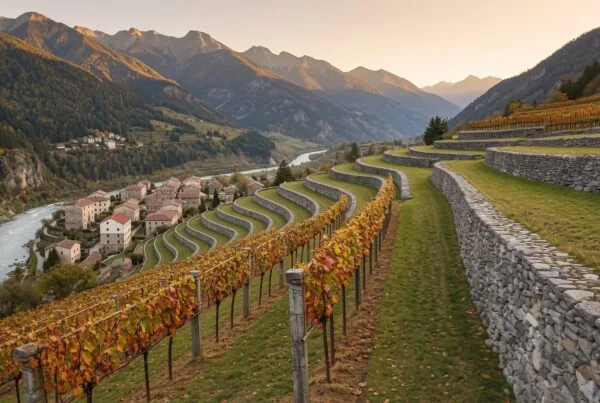
Barolo is born in a precise and unmistakable place: the Langhe. Hills that do not seek grandeur, but continuity. They rise and fall softly, changing exposure at every curve. It is a landscape that does not impose itself at once, but reveals itself slowly. Just like the wine it produces.
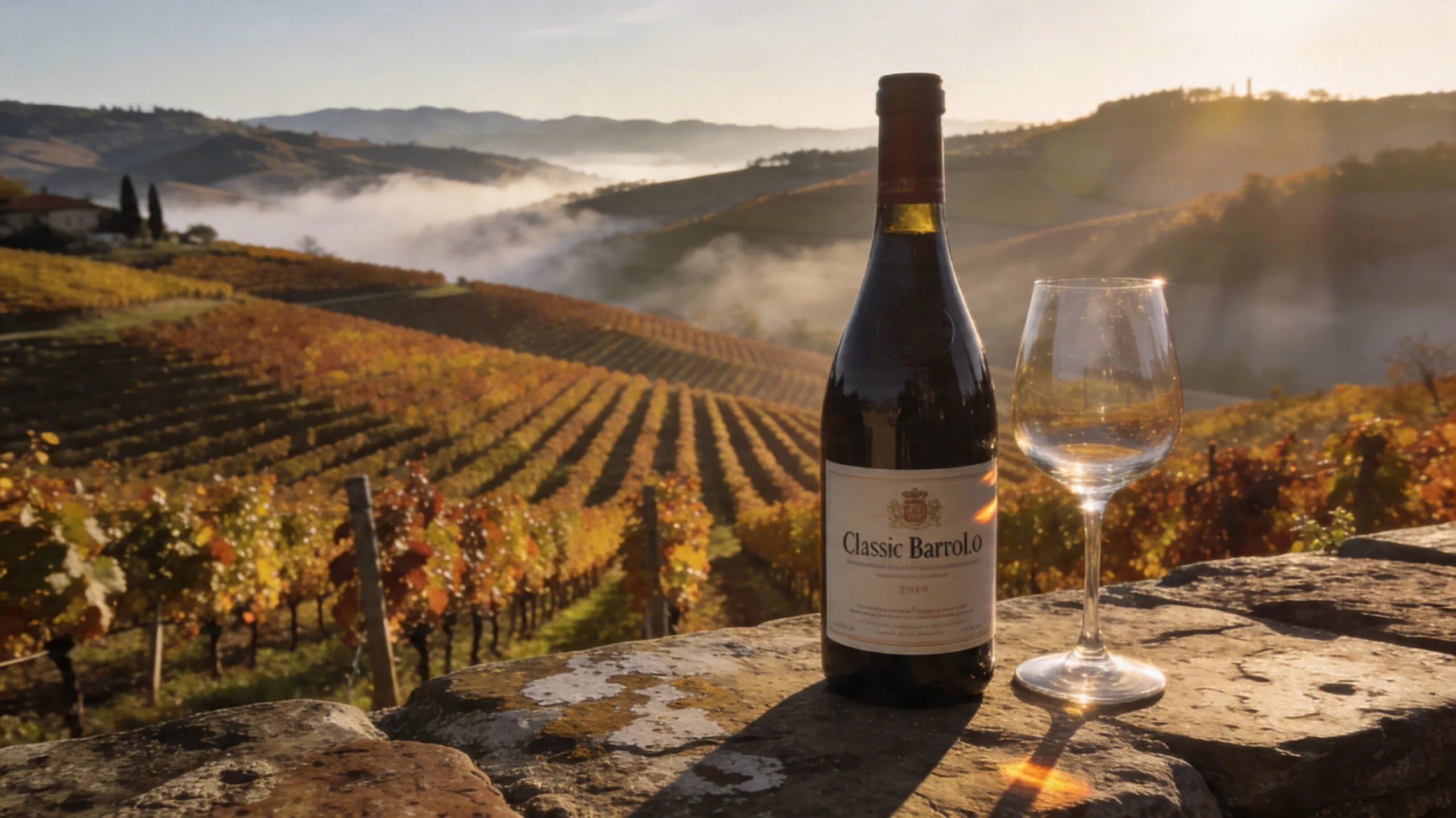
Here, Nebbiolo finds one of its deepest expressions. It is a demanding grape, late-ripening and sensitive. It needs light, air and balance. It matures slowly, often last of all, when autumn is already advanced and the mist begins to lift from the valleys. Even its name seems to carry that suspended atmosphere. This slowness is not a limitation. It is a condition.
And there is one detail that makes it all even more precious. In Piedmont, Nebbiolo, despite being the region’s most revered grape, covers only a small share of the overall vineyard area: about ten percent. It is as if the land granted it little space, yet an enormous role. When a grape is that rare, every decision weighs more. Every harvest becomes a statement.
Barolo DOCG is among Italy’s most rigorous denominations, not out of a desire to control, but out of respect for the wine’s nature. The rules set low yields, up to 80 quintals per hectare, so the vine can concentrate its energy rather than scatter its voice. It is a refusal of abundance that becomes identity, a way of saying that greatness here is born from restraint.
Ageing, too, speaks this language. Barolo must rest for at least 38 months before release, with a minimum of 18 months in wood. The Riserva requires an even longer wait, at least 62 months in total. This is not complication for its own sake. It is the time Nebbiolo needs to become readable, to turn strength into balance and severity into depth.
The production rules do not impose a single barrel format, and that freedom is part of the beauty. Wood is a language, not a disguise. In Barolo, time often passes in oak, and in some official readings of the rules, chestnut is also mentioned: woods that should not cover the wine, but accompany it. The difference, as always, is intention. Large traditional casks can feel like a long breath, while other choices may leave a more visible imprint. In any case, wood here is not decoration. It is patience.
The production area is a mosaic that looks small only on paper. It includes eleven villages, each offering a different nuance. Barolo, La Morra, Monforte d’Alba, Serralunga d’Alba, Castiglione Falletto. Names that, for wine lovers, sound like chapters. And within those chapters, the land changes. Compact marls, lighter sands, warmer slopes and more ventilated exposures create differences you can taste even within a few kilometres. Barolo is never just one thing. It is plural, even when it speaks with a single grape.
Because it is made exclusively from Nebbiolo. No blending, no shortcuts. It accepts the risk of total identity. It does not simplify the territory. It amplifies it. And in this deep dialogue between place, time and discipline, Barolo finds its most authentic voice.
The Wine of the King: A Story Born at Court
Modern Barolo did not appear from a single spark, but from a rare meeting of vision, culture and competence. At the centre of this turning point stands Giulia Colbert Falletti, Marchesa of Barolo, an educated, cosmopolitan woman deeply tied to her land, alongside her husband Carlo Tancredi Falletti, Marquis of Barolo, custodian of the vineyards and estates that would give Nebbiolo a new destiny.
Around 1830, as Piedmont began to look beyond its borders with growing ambition, the Marchesa made a decisive move. She brought in Louis Oudart, a French oenologist experienced in the dry, long-lived wines of the time. It was a pivotal step, because until then Nebbiolo wines, often made in irregular ways, could be sweet or unstable, not always built to travel or to last.
With Oudart came a new idea of winemaking: more complete fermentations, greater stability, and the shaping of a dry wine capable of moving through time. Not an imitation of France, but a translation. Technique may arrive from afar, but the voice remains unmistakably Langhe. This is how Barolo began to resemble the Barolo we know today: a wine that does not chase immediate impact, but a depth that grows with patience.
Barolo soon found its place at the Savoy court, and later within the culture of a newly unified Italy. The expression “the Wine of the King” became tied to its presence on royal tables, through figures such as Vittorio Emanuele II and Vittorio Emanuele III, Kings of Italy, who strengthened its image as a wine of representation. Not because it was an aristocratic whim, but because it embodied a form of prestige built on discipline and endurance.
Yet the most enduring part of this story is not the court itself, but its meaning. Barolo becomes great when it stops being only wine and becomes identity. When a place manages to turn its landscape into a recognisable signature. When a bottle does not speak only of flavour, but of an idea: restraint as nobility, patience as value, strength that never needs to raise its voice.
The First Encounter with Barolo
The first time you meet Barolo, it is probably not what you expect. In the glass, the colour is lighter, almost transparent. You pause, look again. It does not resemble the powerful wine you imagined. Already, you sense that this wine is in no hurry to please.
You bring the glass to your nose and the aromas arrive slowly. Dried rose, damp earth, a hint of forest floor. They do not come toward you. You must step toward them.
Then you taste. The sip is tense, sometimes angular. Tannins are present, acidity is alive. Barolo does not try to envelop you, does not take you by the hand. It seems to say: stop, listen.
If you give it time, something changes. The wine opens gradually, not becoming easier, but clearer. The sensations connect, the sip relaxes. It is not trying to win you over. It is speaking to you.
Barolo is not a wine to drink in haste. It is a wine to meet. And like certain meaningful encounters, you understand it fully only afterwards.