

Where the vine grows closest to the sky
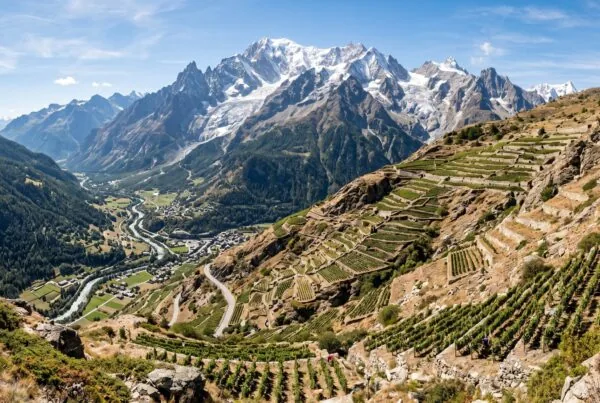
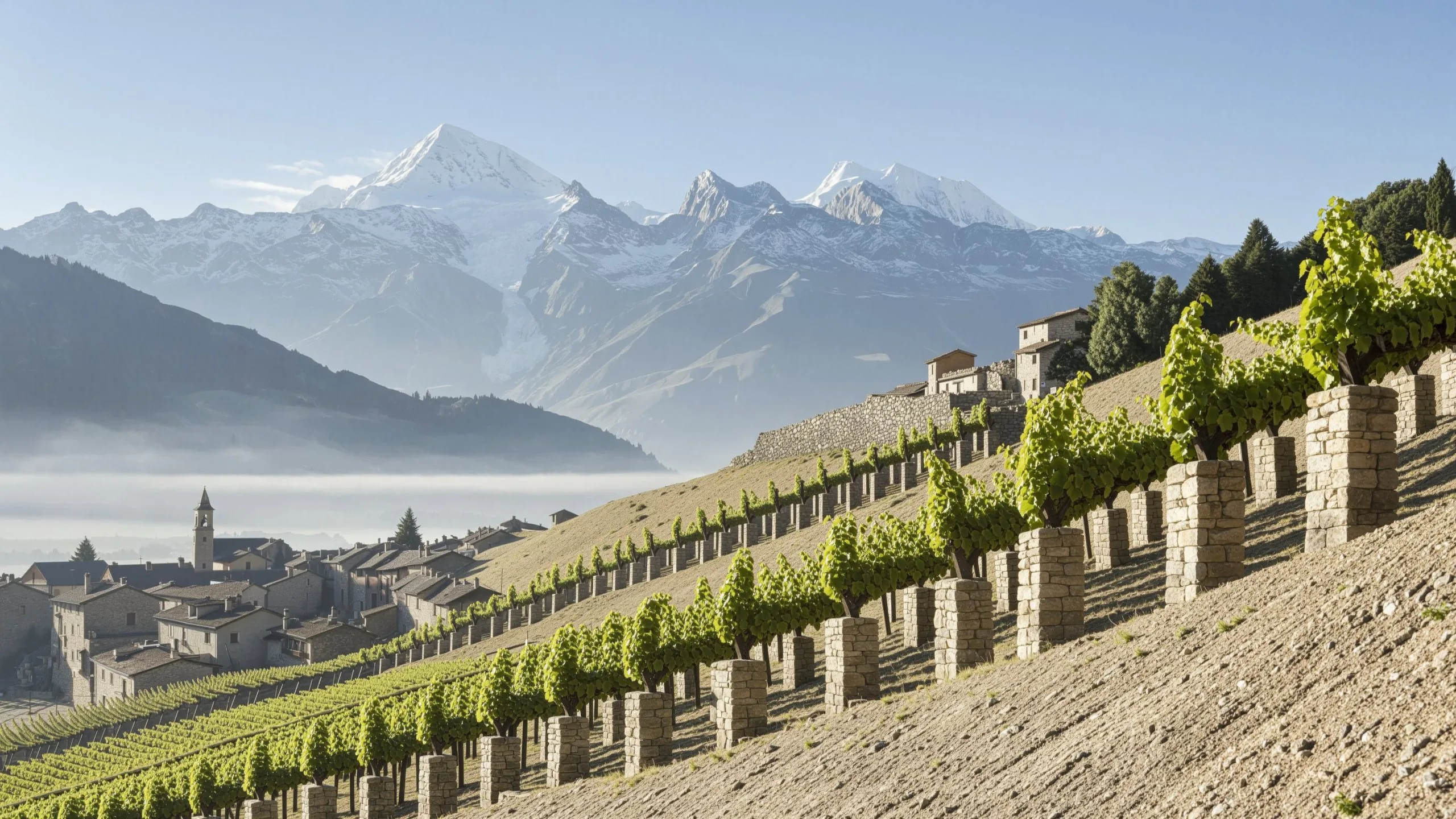
At the foot of Mont Blanc lies a place where viticulture reaches one of its most extraordinary limits.
Here, between the villages of Morgex and La Salle, vineyards climb to nearly1,200 metres above sea level, making this one of the highest wine-growing areas in Europe.
At these elevations, the vine lives by entirely different rules.
Winters are long.
Spring arrives slowly.
Summers are short, yet brilliantly bright.
Every sunny day becomes precious, helping the grapes reach full ripeness before autumn returns.
It is a demanding environment, yet one that is remarkably well suited to viticulture.
TheBlanc de Morgex et de La Salle DOC, established in 1983, is produced exclusively fromPrié Blanc, an ancient native grape variety that has adapted to these extreme conditions over centuries.
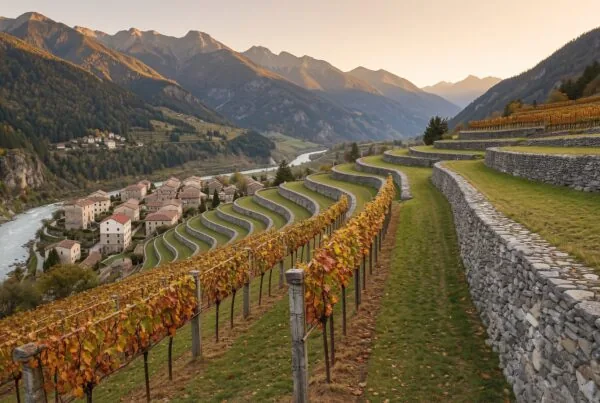
The vineyards are traditionally trained using thelow Aosta Valley pergola system, designed to protect the vines from strong Alpine winds and heavy winter snowfall, and to make the most of the warmth reflected by the stony ground.
The result is a wine that does not seek power.
It seeks purity.
Delicate aromas of Alpine flowers, green apple, citrus and mountain herbs are accompanied by vibrant freshness and remarkable minerality, making every sip a faithful expression of the landscape from which it comes.
Here, wine tells more than the story of a mountain.
It tells the story of the vine’s extraordinary ability to thrive where cultivation would seem almost impossible.
And perhaps that is the greatest lesson of Blanc de Morgex et de La Salle.
The closer the vineyard grows to the sky,
the more essential the wine becomes.
The Mountain That Stopped Phylloxera
Why Blanc de Morgex et de La Salle is unlike anywhere else
At the end of the nineteenth century, European viticulture faced one of the greatest crises in its history.
A tiny insect native to North America,phylloxera, began attacking the roots of European grapevines, killing them within just a few years.
Entire vineyards disappeared.
Regions that had produced wine for centuries saw their viticultural heritage devastated.
The solution came through an innovation that would save the world’s vineyards: grafting European grape varieties onto American rootstocks, naturally resistant to the pest.
Even today, almost every vineyard in Europe grows on American rootstocks.
But at the foot of Mont Blanc, something remarkable happened.
The extreme altitude, harsh winters and sandy glacial soils created an environment where phylloxera simply could not survive.
As a result, manyPrié Blancvineyards continue to growon their own original roots, without ever being grafted.
It is an extraordinary rarity.
Not only from an agricultural perspective,
but from a historical one as well.
Walking through these vineyards is like stepping back in time, seeing the vine exactly as it was cultivated throughout Europe before the arrival of phylloxera.
It is a window into a past that has almost disappeared everywhere else.
And it is this extraordinary combination of mountains, climate and history that makes Blanc de Morgex et de La Salle one of the world’s most fascinating wine regions.
PRIÉ BLANC
The grape born for high altitude
Not every grape variety could survive at more than one thousand metres above sea level.
Prié Blanc, however, seems to have been born for exactly this environment.
Cultivated in the Aosta Valley for centuries, it is one of the Alpine region’s most remarkable native grape varieties. Its growing cycle is perfectly suited to the valley’s short, luminous summers, while its naturally high acidity allows it to retain freshness and balance even in the warmest vintages.
Its production is necessarily limited.
The demanding climate, steep slopes and almost entirely manual viticulture make every harvest an exercise in precision.
Yet it is precisely these challenges that define the character of the wine.
Prié Blanc does not impress through concentration or power.
It captivates through finesse.
Through elegance.
And through its unique ability to express the mountain air, the crystalline light and the dramatic landscape from which it is born.
It is the quiet protagonist of one of Europe’s most extreme wine-growing environments.
Because, in the end, Blanc de Morgex et de La Salle is not simply one of the continent’s highest vineyards.
It is proof that even in the most challenging conditions, nature can still find its perfect balance.