

Where Nebbiolo Meets the Alps
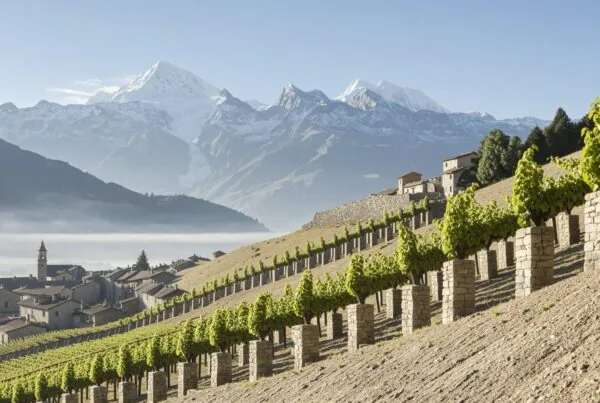
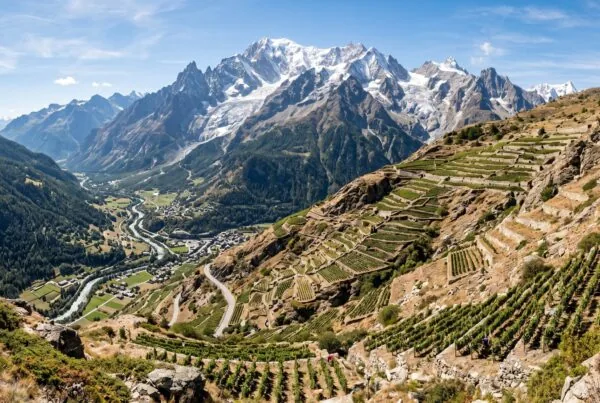
At the point where the Aosta Valley opens toward Piedmont, the landscape changes once again.
The mountains still dominate the horizon, but the slopes become gentler, and the Dora Baltea River guides the valley toward lower elevations. It is here thatDonnas DOCis born, one of Italy’s oldest appellations and one of the places where Nebbiolo reveals a remarkably different personality.
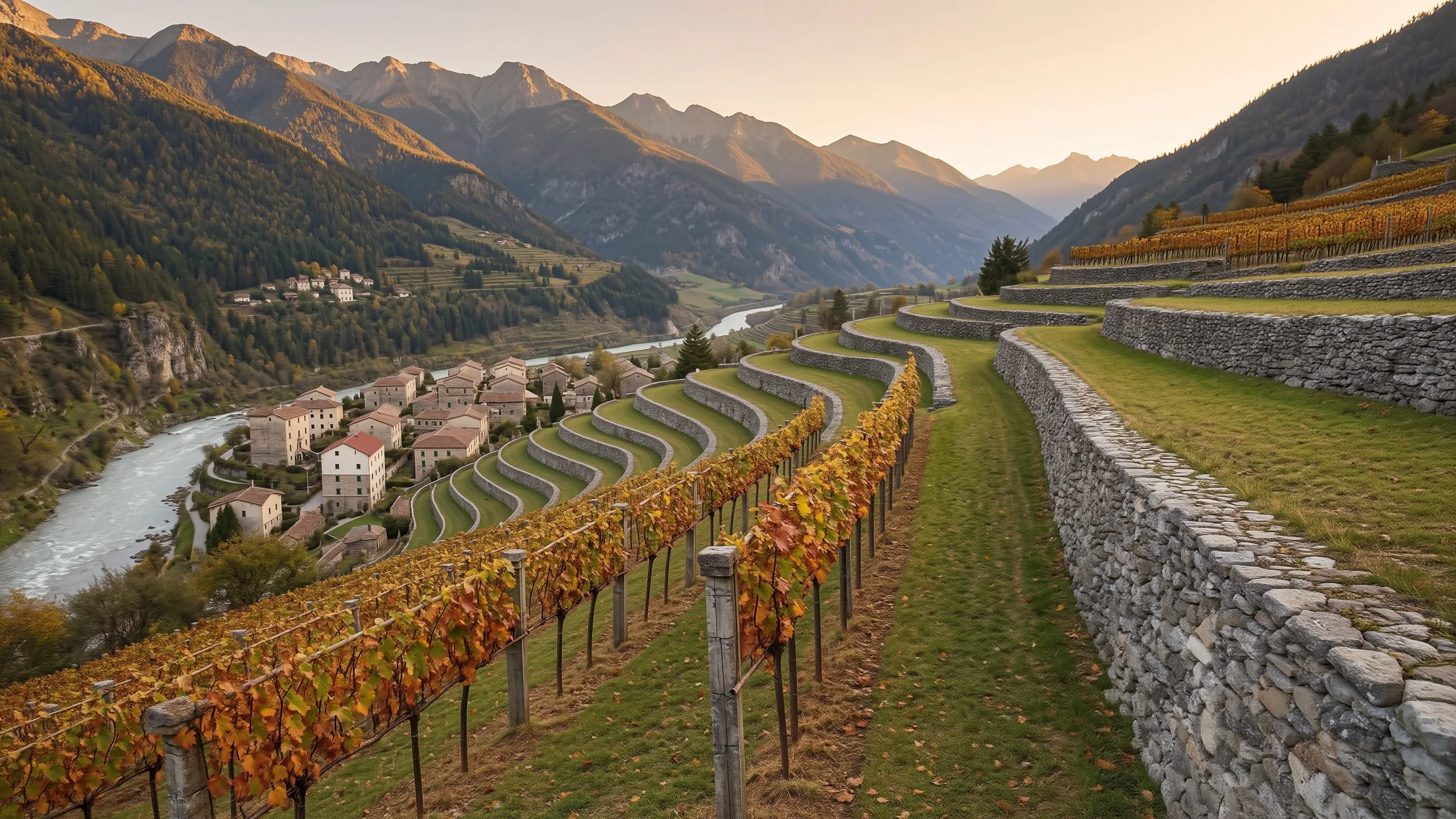
Established in 1971, the appellation takes its name from the village of Donnas, located at the gateway to the Aosta Valley. Here, Nebbiolo—known locally asPicotendro—has been cultivated for centuries on steep terraced vineyards supported by ancient dry-stone walls, creating a landscape shaped by generations of patient craftsmanship.
The Alpine climate, dramatic day-to-night temperature swings, and soils rich in sand and glacial rock give these wines a refined and essential character.
They do not seek power.
They seek elegance.
Their aromas recall wild red berries, violets, mountain herbs, and delicate spice, while vibrant acidity supports fine tannins and a remarkable ability to age gracefully.
Donnas proves that the same grape variety can tell entirely different stories.
Sometimes, all it takes is a different landscape.
PICOTENDRO
Why is Nebbiolo called Picotendro in the Aosta Valley?
Most wine lovers know Nebbiolo as the grape behind Barolo and Barbaresco.
Few realize that, after crossing the western Alps, it even takes on a different name.
In the Aosta Valley, Nebbiolo has long been known asPicotendro.
It is not a different grape variety.
It is the very same great Piedmontese grape, shaped over centuries by the unique conditions of the valley.
High altitude, an Alpine climate, and dramatic temperature swings slow the ripening of the grapes, producing wines with greater finesse, elegant tannins, and remarkable aromatic precision.
Here, Nebbiolo does not lose its identity.
It simply expresses it differently.
It is one of the clearest examples of how terroir can transform the character of a grape without changing its nature.
The name Picotendro tells exactly that story.
The same protagonist.
An entirely different landscape.
THE TERRACED VINEYARDS OF DONNAS
Where the mountain becomes a vineyard
Looking across the vineyards of Donnas, it is difficult to imagine how many generations were needed to create this landscape.
The vines grow on narrow terraces supported by dry-stone walls, where every row has been carved from the mountainside, one stone at a time.
Here, nearly every task is still carried out by hand.
Not because of tradition alone.
But because the land leaves no other choice.
This is one of the purest expressions ofheroic viticulture, where human effort does not seek to dominate nature, but to live in harmony with it.
Walking among these vineyards is like walking through history.
Every stone wall tells the story of time.
Every vineyard row tells the story of perseverance.
Every harvest renews a fragile balance between people and the mountain.
And perhaps that is the greatest legacy of Donnas.
Not simply producing one of the Alps’ most elegant expressions of Nebbiolo.
But proving that some of the world’s greatest wines are born first from the determination of those who continue cultivating places that seem almost impossible.