

Where the vine becomes architecture
At the northernmost edge of Piedmont, on the border with Valle d’Aosta, along the Dora Baltea and at the entrance to the Mont Blanc valley, the landscape shifts without transition. The hills of the Langhe are now far behind. Here begin the true Alps, made of rock, steep slopes and vertical light.
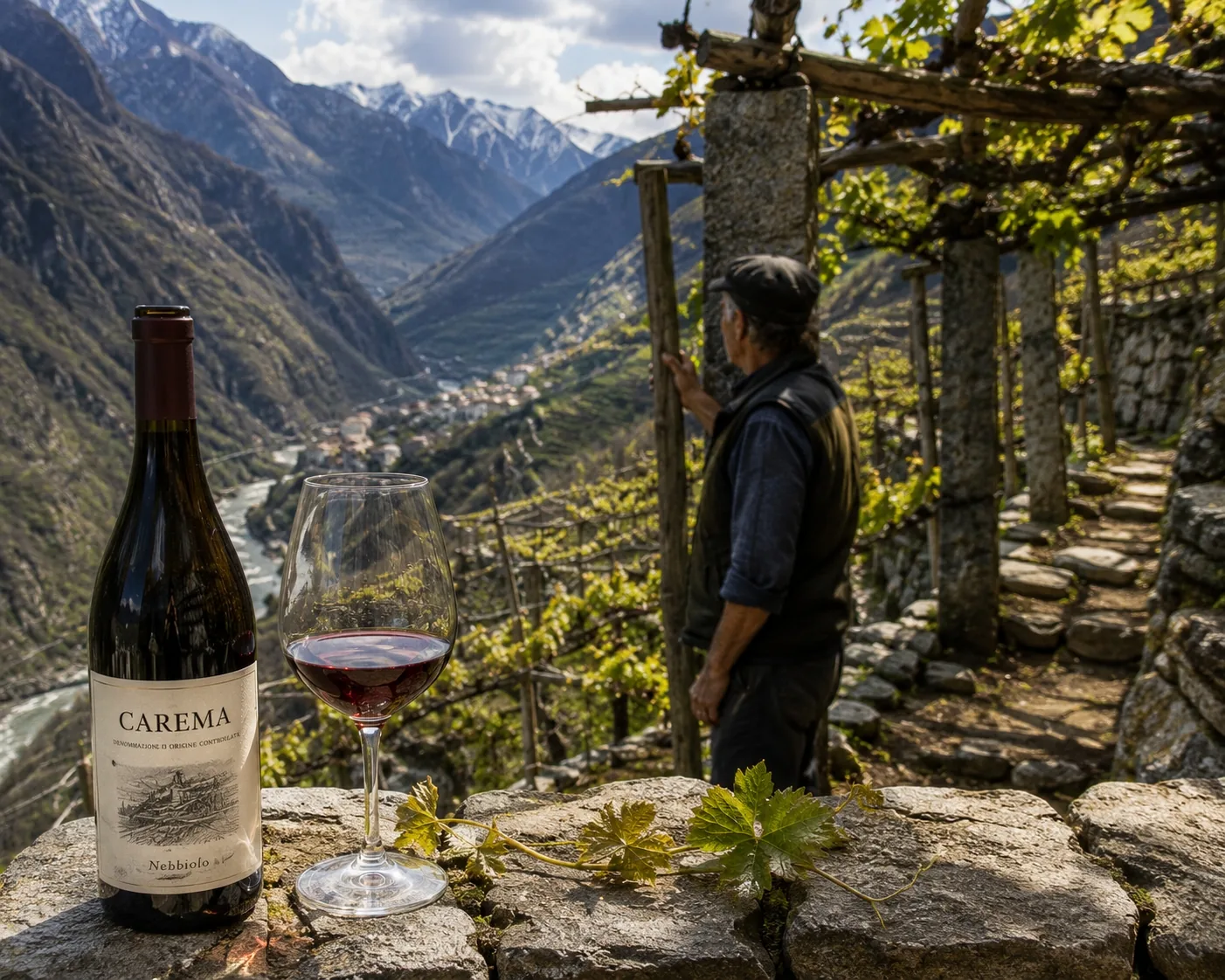
It is in this precise place, in the village ofCaremain the province of Turin, that one of the most extreme forms of viticulture in Italy takes shape.
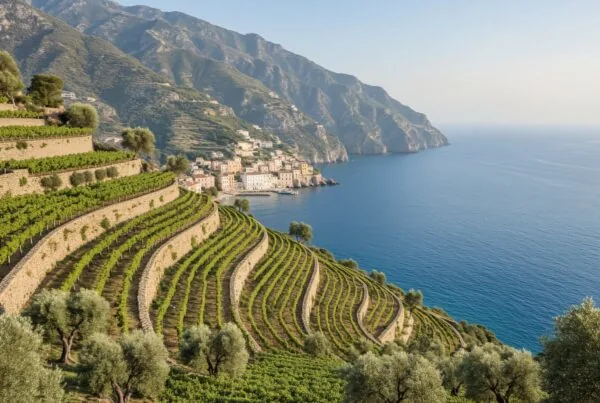
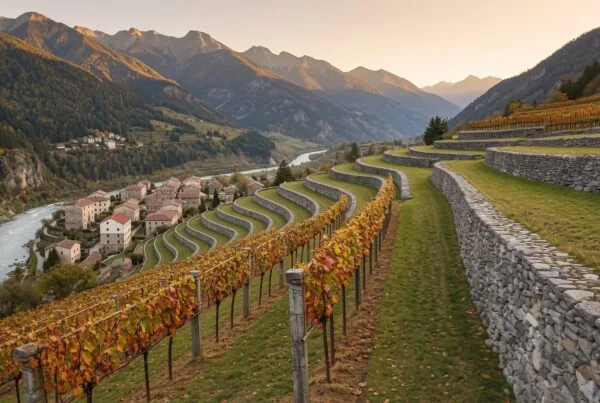
The vineyards cling to south-facing slopes, carved into the mountain through terraces. There is no flat land, no ease. Every cultivated metre has been built over time, stone by stone, to make possible what would not naturally exist.
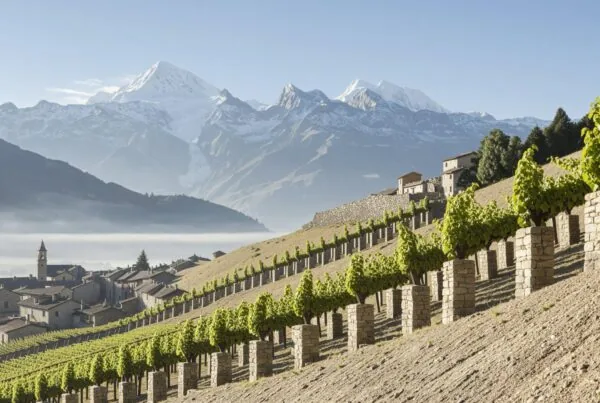
The pergola systems supported by stone pillars, locally known as “topie”, are not decorative elements. They are a precise structure that allows the vine to grow, protecting it from temperature swings and distributing the warmth stored in the rock.
Here, viticulture does not simply adapt to the landscape. It reshapes it.
The grape isNebbiolo, which in this area finds one of its most subtle and vertical expressions. The alpine climate slows everything down. Ripening is long, acidity remains high, structure becomes lighter.
The wine does not seek volume. It moves through tension.
Caremais a place at the limit. And for that reason, one of the most precise.
Effort as a measure
TheCaremaDOCregulations reflect a reality that is profoundly different from the great Piedmontese appellations.
Nebbiolois the main grape, but it may be supported by small percentages of local varieties. Not to change the wine, but to sustain it in such an extreme environment, where every balance is more fragile.
Yields are naturally low. This is not a stylistic decision. It is a direct consequence of the land. Here, producing large quantities is simply not possible.
Time follows a different logic as well.Caremarequires shorter ageing periods compared to the great Nebbiolos of the Langhe, but enough to stabilise a wine that is already tense, already defined.
Wood plays a supporting role. It cannot dominate, because the material is more delicate, more sensitive.
The result is a wine that is not built through accumulation, but through subtraction. Everything that is unnecessary is removed.
What remains is the essential.
Mountain Nebbiolo
When the grape changes pace
InCarema,Nebbiolodoes not change identity. It changes rhythm.
Lower temperatures, strong temperature swings and altitude slow down the ripening process. The vine works more slowly, accumulates less sugar, retains higher acidity.
This is directly reflected in the wine.
The colour is lighter, the structure less broad, but the tension is more evident. The palate is sharp, continuous, often longer than it is wide.
It is not aNebbiolothat imposes itself. It is a Nebbiolo that reveals itself.
It requires time, attention, listening. And precisely for this reason, it leaves a more defined impression.