

The white that looks toward the sea
Piedmont is not only red.
There is a point, to the south, where the landscape changes direction once again and wine takes a different path. The hills soften, the air moves differently, and the sea, though not visible, makes itself felt.
We are in theGaviarea, in the southernmost part of Piedmont, in the province of Alessandria, just a few kilometres from the Ligurian border. The zone develops around the town of Gavi and stretches across open valleys and hills that begin to face the Apennines. The Ligurian Sea lies just over thirty kilometres away as the crow flies, and its presence is reflected in the climate, bringing ventilation and a different kind of light.
It is a territory of passage, historically shaped by exchanges between inland and coast. And this dual nature is felt in the wine: a Piedmontese structure, more tense and vertical, and a freshness that seems to come from the sea.
The grape isCortese. A variety that does not seek power, but definition. It does not build volume, but works on precision. It seems made for this place, capable of translating the landscape into a clear language.
The soils are mainly calcareous, with clay and marl that retain water without weighing down the vine. It is a land that does not force the plant, but guides it. And the result is a wine that moves naturally, without excess.
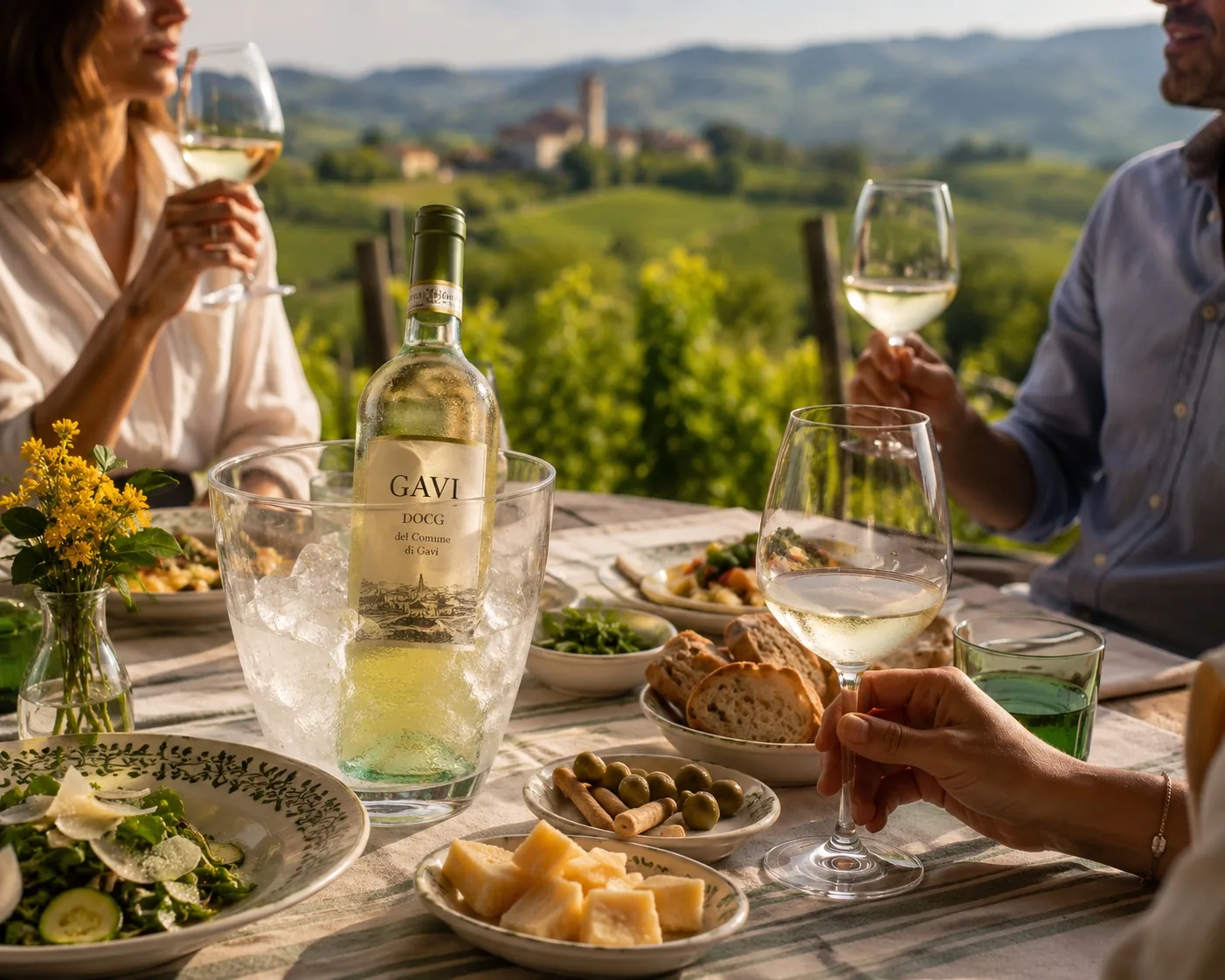
In the glass,Gavistands out for its linearity. It does not aim for layered complexity, but for direct expression. Freshness, tension, a clean finish. It is a wine that does not require long explanations, because it finds balance in its essential nature.
Gaviis one of those places where white wine is not an alternative. It is a choice. And within Piedmont, it represents a different, necessary voice.
The shape of freshness
Gavi follows a clear line: preserving identity and clarity.
The regulations require the exclusive use ofCortese, with no possibility of blending. It is a precise choice, reinforcing the bond between grape and territory.
Yields are controlled, not to build structure, but to avoid dispersion. Here, quality does not come from intensity, but from precision.
Vinification takes place primarily in stainless steel, a choice that preserves aromatic integrity and freshness. The regulations do not impose long ageing, but allow for interpretations that may include time on lees or more complex developments, such asGaviRiserva.
Time, in this context, does not build the wine. It refines it. It sharpens identity rather than transforming it.
In the glass, everything aligns.Gaviis a wine that does not rely on technique, but on coherence. Every choice, from vineyard to cellar, seems aimed at maintaining a precise line.
It is a white that does not seek depth through weight, but through clarity.
Cortese
A grape that does not try to impose itself
Corteseis one of those grape varieties that does not easily attract attention. It does not have the aromatic force of other grapes, it does not build explosive perfumes, it does not impose itself.
And that is precisely why it works.
It is a grape that operates by subtraction. It reduces, simplifies, removes the unnecessary. It allows what truly matters to emerge: freshness, balance, definition.
InGavi, it finds its most complete expression. The territory allows it to retain acidity, to develop a precise structure, to create a wine that moves with continuity.
Corteseis not a grape that changes the wine. It is a grape that makes the wine readable.
And in a world that often seeks impact, this is a rare quality.