


Old World and New World: Two Ways of Thinking About Wine
After observing wine from above, as a map made of climates and continents, it is time to come closer. To lower the altitude. To approach the vineyards, the hands that work them, the ideas that move through them. Because at a certain point in recent history, wine began to describe itself through a distinction that is simple only on the surface.Old World and New World.Two expressions that do not merely indicate geographic origin, buttwo different ways of thinking about wine and its relationship with time.
The Old World: Memory, Continuity, and Landscape
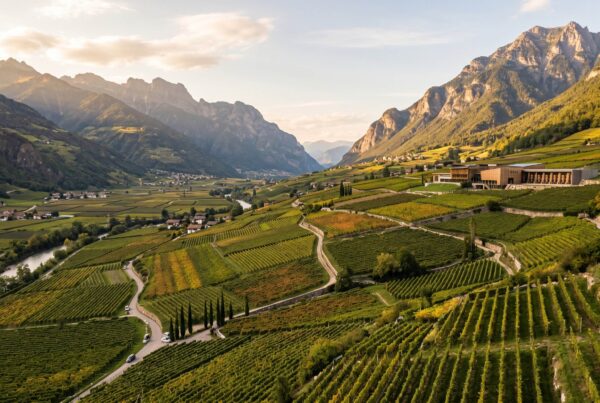
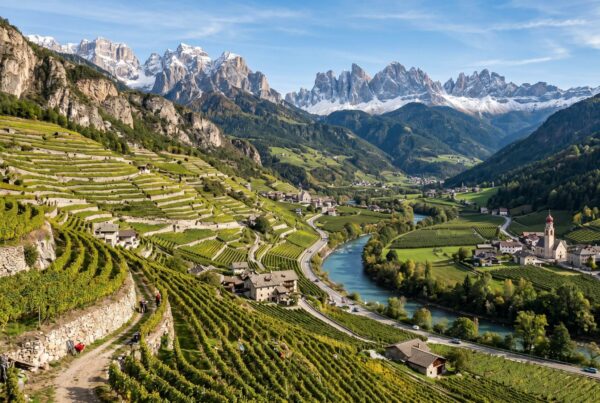
For centuries, European wine was the only reference. It was born in places where the vine had grown for generations, often on the same plots of land, guided by unwritten rules deeply absorbed over time. Wine did not need to explain itself. Naming the place was enough. A name, a hill, a valley. Wine was part of the landscape, of the table, of everyday life.It was memory before it was product.
In this context, quality was not constructed. It was lived through. Each harvest added something, but nothing erased what came before. Wine grew out of the acceptance of limits, of climate, of difficult seasons. It did not seek immediacy. It did not aim to please everyone. It asked for time and attention.
The New World: Clarity, Technique, and Direct Expression
Then the vine truly began to travel. Between the late nineteenth century and the twentieth, it crossed oceans and took root in places without a long wine history behind them.California, South America, Australia, New Zealand, South Africa.Here, wine could not rely on tradition. It had to build a new language, make itself understood immediately, tell its story without inherited references.
This is how the concept of theNew Worldemerged. Not as an ideological challenge, but as a practical response. In these regions, wine was conceived in a more direct way. Fruit became central, technique a necessary tool, clarity a value.Wine had to speak at the first sip, without requiring prior knowledge.

During the 1970s and 1980s, this difference became unmistakable. New World wines gained international markets and attention, proving a simple truth.Quality was not the exclusive domain of Europe.For the first time, the Old World was forced to pause, to observe, to reconsider its own language.
Over time, however, neither world remained still. Europe became more aware, more precise, more transparent in its work. New producing countries began to search for depth, identity, and connection to place. Conversations shifted toward soils, exposures, parcels, internal differences.
Today,Old World and New World are no longer opposing poles.They are two sensitivities that observe and influence one another. Wine has stopped choosing sides. It has learned to move between them, taking what it needs.Tradition and innovation do not cancel each other out. They meet.
Chianti Classico: When a Place Becomes a Name
As early as the seventeenth century, the wine produced in the hills between Florence and Siena was known and appreciated well beyond the borders of Tuscany. The nameChiantibegan to circulate on European markets, appearing in commercial records and travel accounts. It did not yet refer to a precisely defined area, but it evoked a recognizable origin, an idea of quality tied to that hilly landscape.

It was precisely this growing reputation that revealed a problem destined to become central in the history of wine. The name began to be used for wines produced outside the area of origin, exploiting its value without sharing its characteristics. At a time when wine trade had already taken on a significant international dimension,the value of a name could easily be diluted if it was not protected.
It was within this context that, in 1716,Cosimo III de’ Medici, Grand Duke of Tuscany, issued a decree that would leave a lasting mark on the history of wine. Through this official act, the production areas of several wines of the Grand Duchy were precisely defined, including Chianti.For the first time, the name of a wine was formally linked to the name of a specific geographic area.
This moment represents one of the earliest historical examples ofgeographic protection in wine.It is not yet the system of appellations as we know it today, but it clearly anticipates its founding principle.The identity of wine is recognized as inseparable from the place in which it is born.
From this historical intuition, what we now know asChianti Classicogradually took shape, becoming one of the most recognized wine denominations in the world. Not as an artificial construction, but as the evolution of a way of thinking born centuries earlier. In a world where wine was beginning to travel more and more, territory became the fixed point, the guarantee of authenticity.The place did not limit the wine. It gave it meaning.
Join the conversation.
What does wine mean to you: place, memory, culture, or transformation?
Share your thoughts with us in the comments on Instagram:@oratiowine