

Where water becomes wine
If Collio and the Colli Orientali tell the story of the hills, the Isonzo tells the story of a river.
Here, the landscape changes once again.
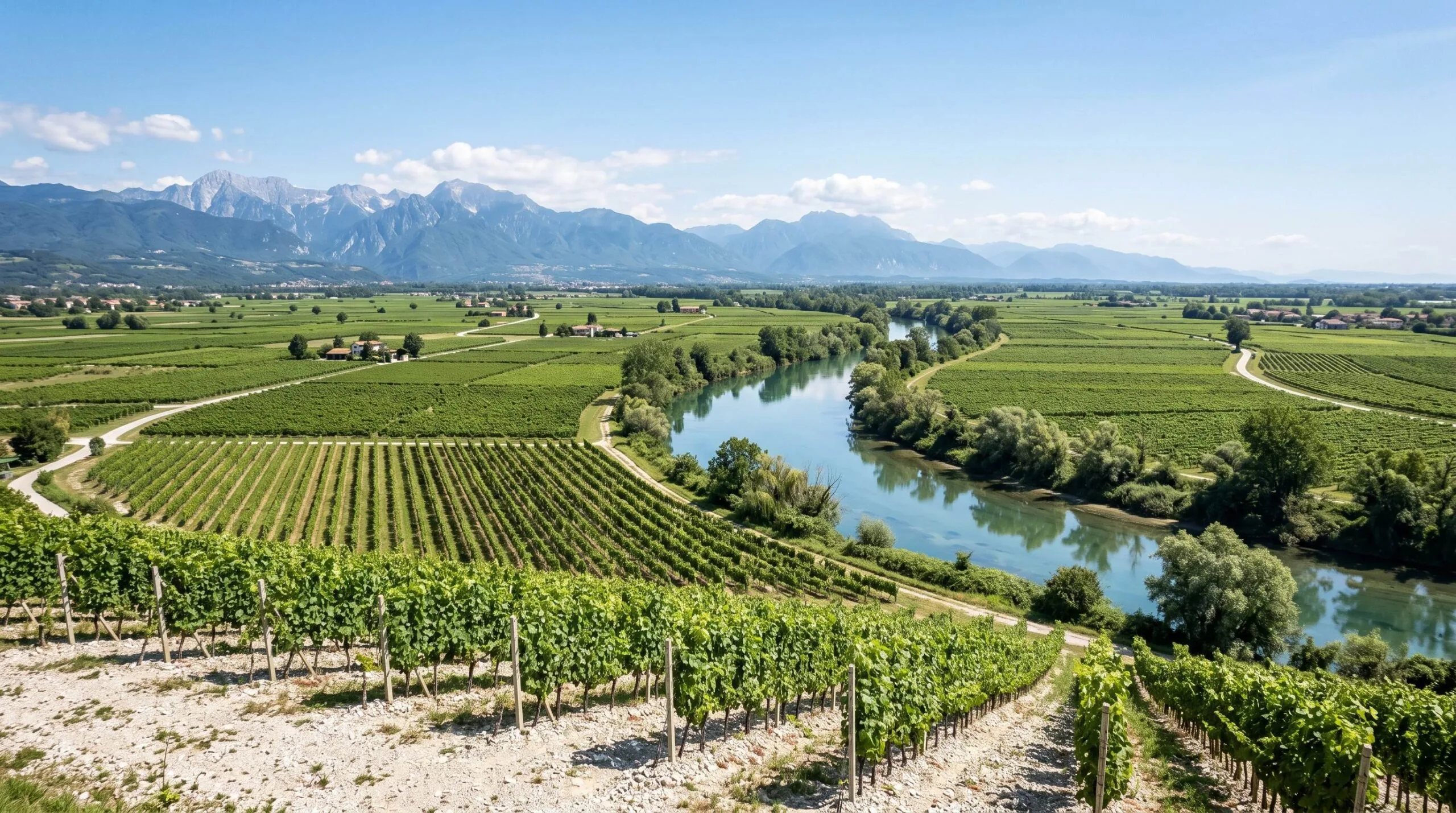
The slopes soften, giving way to an open plain shaped by one of north-eastern Italy’s most important waterways. The Isonzo River, with its unmistakable emerald-green waters, descends from the Julian Alps to the Adriatic Sea, sculpting the surrounding landscape over thousands of years.
It is the river itself that created this territory.
Century after century, it deposited vast layers of gravel, sand and rounded stones, forming exceptionally well-drained soils. Water never lingers here. The vines are forced to send their roots deep into the ground in search of moisture, developing a natural balance that is reflected in every glass.
TheIsonzo del Friuli DOC, officially recognised in 1974, protects this unique territory stretching between the river and the Gulf of Trieste. Alongside native grape varieties, a number of international cultivars have found remarkable expressions on these soils.
Sauvignon Blanc develops remarkable tension and aromatic precision.
Chardonnay stands out for its elegance and balance.
Pinot Grigio reaches one of its finest interpretations.
Even the red varieties, from Merlot to Cabernet Franc, benefit from this extraordinary equilibrium, maintaining freshness while gaining complexity with age.
Here, wine is not born from the mountains.
Nor is it born from the hills.
It is born from water.
And perhaps that is the truest signature of the Isonzo.
The Gravel of the Isonzo
When the soil teaches restraint
In Collio, vines sink their roots into ponca.
In the Isonzo, they encounter stone.
The gravel deposited by the river forms one of the poorest viticultural soils in Italy. At first glance, this might seem like a disadvantage.
It is exactly the opposite.
The lack of organic matter naturally limits the vine’s vigour. The plant produces fewer bunches, concentrating its energy into every grape.
The exceptional drainage prevents water from stagnating, while the stones absorb heat during the day and slowly release it at night, encouraging slow and even ripening.
Here, the vine is not assisted.
It is challenged.
And it is precisely through this constant search for balance that wines of remarkable purity, precision and elegance are born.
The Isonzo reminds us that the most demanding soils often produce the most authentic wines.
The River That Connects
When the land follows the water
The denomination does not take its name from a town.
It takes its name from a river.
And that distinction matters.
The Isonzo belongs to no single place. It flows through mountains, plains and national borders, connecting very different landscapes on its journey toward the Adriatic Sea.
Its wines follow the same path.
They do not tell the story of a single hillside, as Collio does.
Nor of a single village.
They tell the story of a landscape shaped by water.
For centuries, the river served as a route for trade, a natural frontier and, during some of Europe’s darkest moments, a battlefield.
Today, however, it continues its oldest task.
Giving life.
To vineyards.
To fields.
And to the wines that are born along its banks.
Perhaps this is the deepest lesson of the Isonzo.
Some of the world’s great wine regions were not created by people.
They were patiently carved by nature.