

Bolgheri: When the Plain Looked to the Sea and Changed Tuscan Wine
A Coastal Plain with a New Voice
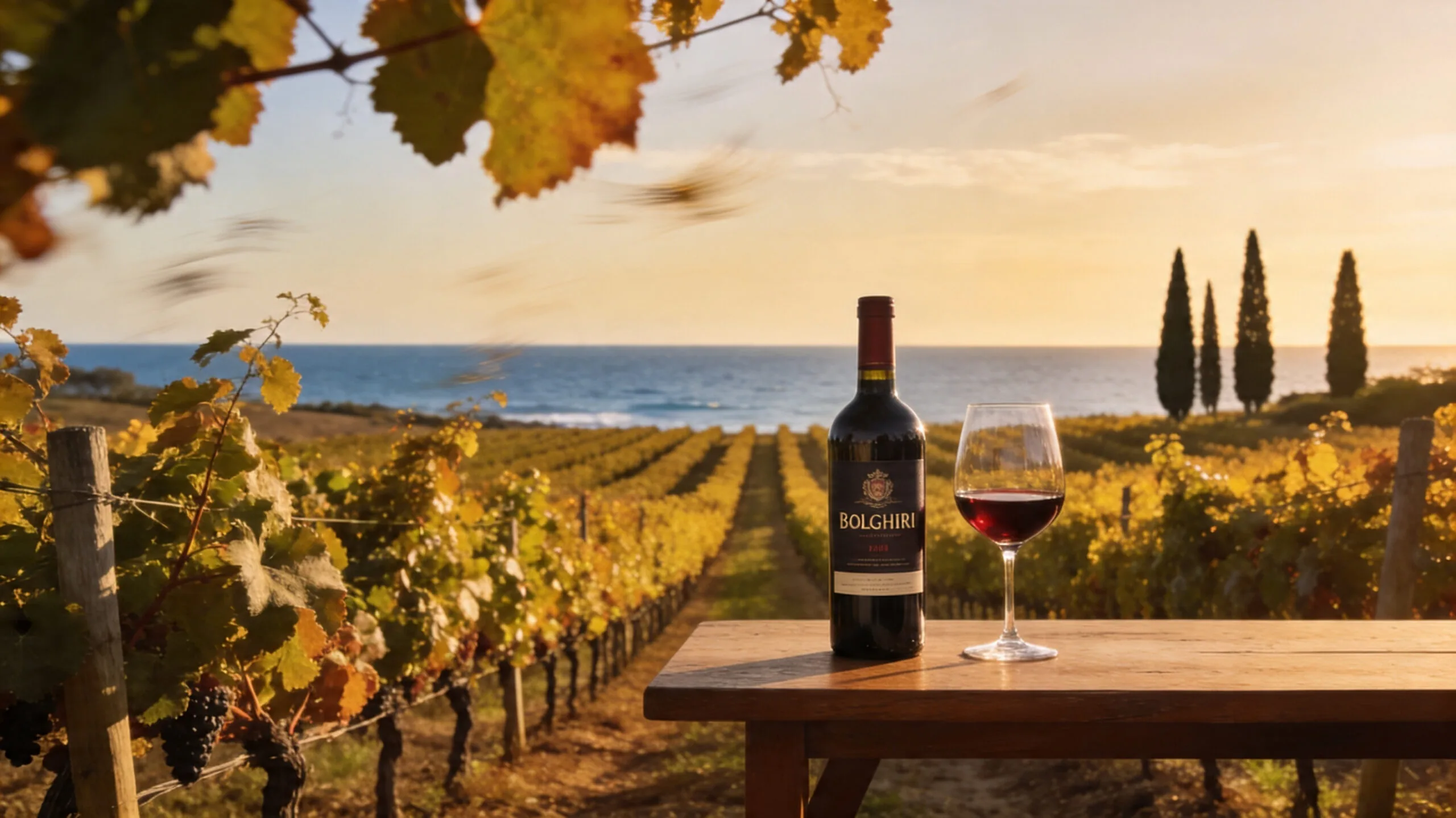
Some places enter wine history not through continuity, but through rupture. Bolgheri is one of them. It does not rise from Tuscany’s iconic hills, nor does it seek altitude as refuge. Bolgheri was born on the coastal plain, along the Tyrrhenian Sea, where wind and light shape the landscape every day.
This is the territory of Castagneto Carducci, a stretch of warm, open land where vineyards grow on flat ground, rooted in alluvial and sandy soils rich in marine sediments. For a long time, no one believed this land could produce wines of depth and longevity. And yet, it was precisely this difference that changed everything.
Bolgheri’s climate is unmistakably Mediterranean. Hot summers moderated by constant sea breezes, mild winters, gentle thermal shifts. The vine does not struggle against cold, but learns to manage heat. Ripening here is complete and unforced. The sea may not always be visible, but it is present, leaving an invisible imprint of freshness and precision in the wines.
The Bolgheri DOC was established in 1992, officially recognizing what the wines had already proven. Its production rules reflect the openness of the territory. International varieties such as Cabernet Sauvignon, Cabernet Franc, Merlot and Syrah are central, sometimes accompanied by local grapes. The message is clear: Bolgheri does not imitate, it interprets.
Yield limits and winemaking practices aim for concentration and balance rather than ideology. Oak is used as a structural tool, never as disguise. Style here is not aesthetic exercise, but a coherent response to place.
Bolgheri tells the story of a Tuscany capable of reinvention without denial. A land that proved identity is not a boundary, but a direction.
Mario Incisa della Rocchetta: The Intuition That Reshaped a Territory
At the origin of Bolgheri lies an individual vision. Mario Incisa della Rocchetta did not intend to found a denomination or rewrite Tuscan wine history. He was simply searching for a wine that reflected his personal taste.
In the mid-twentieth century, he traveled extensively in France, especially Bordeaux, where he admired the elegance and aging potential of great wines. Returning to Tuscany, he made a radical choice: planting international grape varieties in a coastal area considered unsuitable for fine wine.
The surrounding landscape was agricultural in the most basic sense. Vegetable fields, small farms, domestic vineyards. No tradition to follow, no model to imitate. And therefore, total freedom.
There is a legend of vines “stolen” from Bordeaux. The truth is more subtle and more compelling: the vines were carefully selected, acquired, and patiently adapted to a completely different soil. The result was not imitation, but translation.
For years, these wines existed outside any official classification. Not by defiance, but because the system was not yet ready. Season after season, however, they proved that this stretch of coast had its own voice.
Bolgheri was born from this. From a gesture that sought coherence, not approval. From an idea of wine that began as personal conviction and ended by transforming a territory.
Super Tuscan: When Wine Came Before the Rules
Before the rules adapted, the bottles spoke. In the 1970s and 1980s, Tuscany saw the emergence of wines that did not fit existing denominations, yet expressed undeniable quality and character. They were free wines, bold in grape choice and ambitious in style.
The term Super Tuscan was coined by wine writer Burton Anderson and later popularized internationally through the influence of Robert Parker. It was never a legal category, but a cultural one. A way to name something that had not yet found its place.
Super Tuscans were not a rejection of tradition, but its extension. They used international varieties, often outside disciplinary limits, aiming for depth, structure and aging potential. They did not ask permission of the rules. They forced the rules to evolve.
Bolgheri became one of the places where this movement found its most coherent expression. Here, the idea of the Super Tuscan was not transitional, but formative.
Over time, many of these ideas were recognized, regulated and integrated. Yet their deeper meaning remains. Super Tuscans remind us that wine is born from vision, not regulation. Rules come later, once the land has already spoken.