

Where the hills learn to speak
There are places that seem to have been made for the vine.
Collio is one of them.
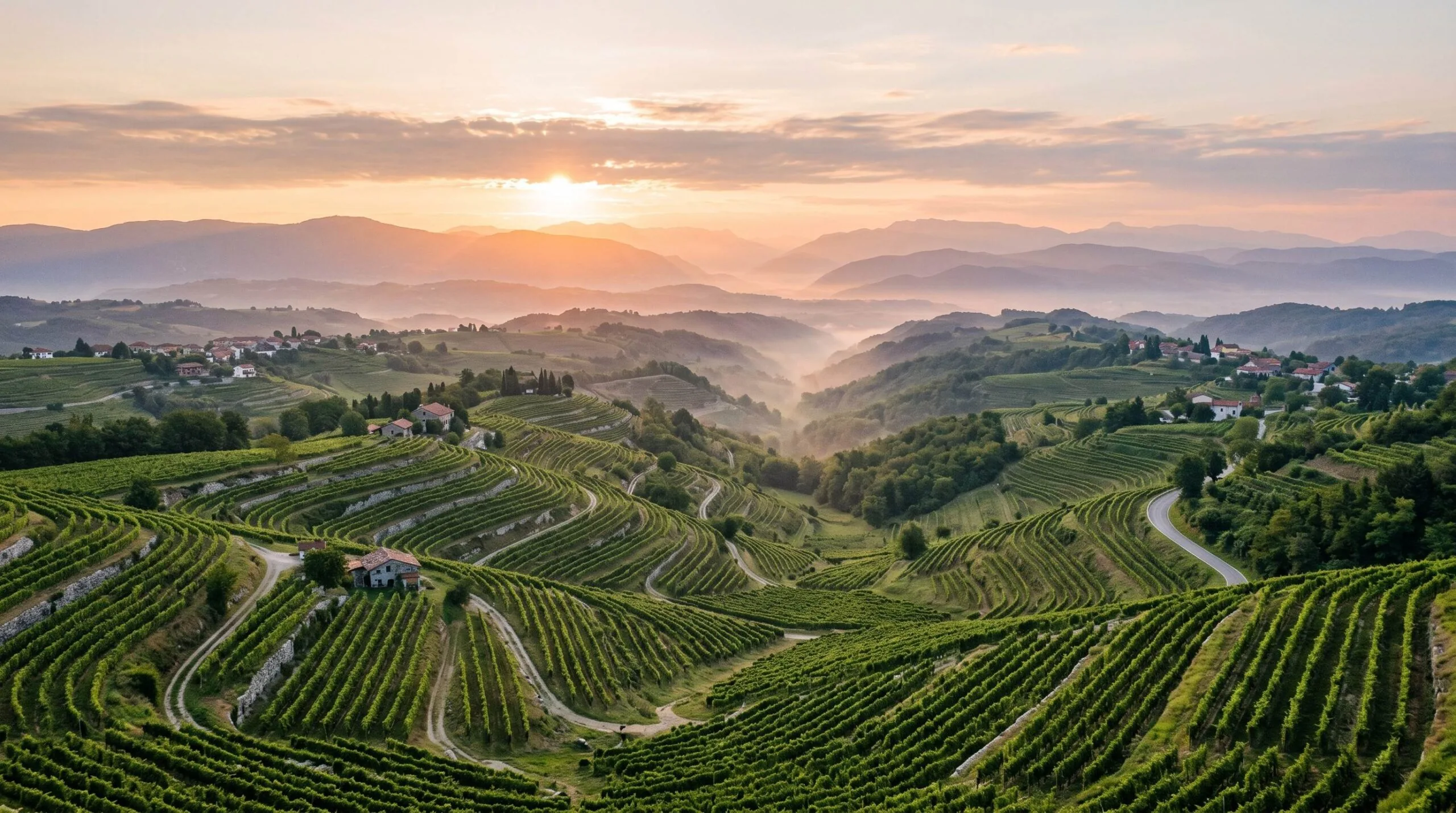
Nestled in Italy’s far north-east, along the border with Slovenia, this gentle succession of rolling hills is considered one of the world’s finest territories for the production of great white wines.
Here, the landscape knows no interruptions. Vineyards cross the border without noticing it, following the natural curves of the hills. Politics divides two countries. The land continues to tell the same story.
The Adriatic Sea, just a short distance away, brings constant breezes that soften the summer heat. The Julian Alps protect the vineyards from the cold northern winds.
Between these two worlds, a rare balance is born.
Significant day-to-night temperature differences allow the grapes to ripen slowly, developing intense aromas while preserving freshness.
It is precisely this balance that theCollio DOC, the first denomination of Friuli Venezia Giulia, officially recognised in 1968, was created to protect.
The appellation includeseleven hillside municipalities in the province of Gorizia, all sharing an extraordinary vocation for viticulture. Here, wines are produced from some of Friuli’s most important native grape varieties, including Friulano, Ribolla Gialla and Malvasia Istriana, alongside international grapes that have found some of their finest expressions in Collio, such as Sauvignon Blanc, Pinot Grigio, Chardonnay and Pinot Bianco.
The disciplinare establishes controlled yields, a strictly defined production area and precise regulations designed to preserve the character of the territory in every bottle. The goal is not to create powerful wines, but to safeguard identity, elegance and the ability to evolve over time.
Because Collio does not seek to impress.
It seeks precision.
Every bottle tells the story of a hillside, a vintage and a balance patiently shaped by nature.
This is why Collio has become one of the symbols of Italian white wine.
Not because it produces wines greater than all others.
But because it expresses its land with a clarity that few places in the world can match.
Ponca
The soil that changed Italian white wines
If Collio has a voice, that voice begins beneath the surface.
Here, one word returns again and again in conversations among growers and winemakers.
Ponca.
It is the local name for the ancient layers of marl and sandstone that were deposited millions of years ago on the floor of a sea that no longer exists.
Over time, these rocks were uplifted, fractured and gradually weathered, creating one of Europe’s most remarkable viticultural soils.
Ponca is fragile.
It crumbles easily underfoot, absorbs water during rainy periods and slowly releases it throughout the summer months.
The vine never truly suffers.
Instead, it is encouraged to push its roots ever deeper, exploring layers rich in minerals and nutrients.
This is one of the reasons why Collio produces wines of remarkable energy and depth.
Ponca does not add flavours.
It does not make a wine “mineral” in the simplistic sense of the word.
It does something far more important.
It creates balance.
It is this delicate equilibrium between water availability, deep root systems and slow ripening that allows the great white wines of Collio to combine richness with freshness, structure with tension, immediacy with an extraordinary capacity to age.
Before discovering a grape variety, in Collio it is worth discovering the land.
Because this is where everything begins.
A Wine Beyond Borders
When the land is stronger than politics
To truly understand Collio, one must forget maps, if only for a moment.
The hills know no borders.
They continue naturally beyond Italy, into Slovenia, where they take the nameBrda.
The soil is the same.
The climate is the same.
The ponca continues uninterrupted.
The culture of wine is equally shared, rooted in generations of families, traditions and vineyards that for centuries have lived this landscape as one continuous territory.
Only the political events of the twentieth century drew a line across it.
Nature, however, never stopped speaking the same language.
Today, on both sides of the border, Italian and Slovenian producers continue to preserve a common heritage, proving that wine remains one of the most authentic languages through which a territory can tell its own story.
And perhaps this is one of Collio’s most fascinating lessons.
Wine reminds us that territories exist long before borders.
And they continue telling their stories long after maps have changed.