

Where wine chooses precision
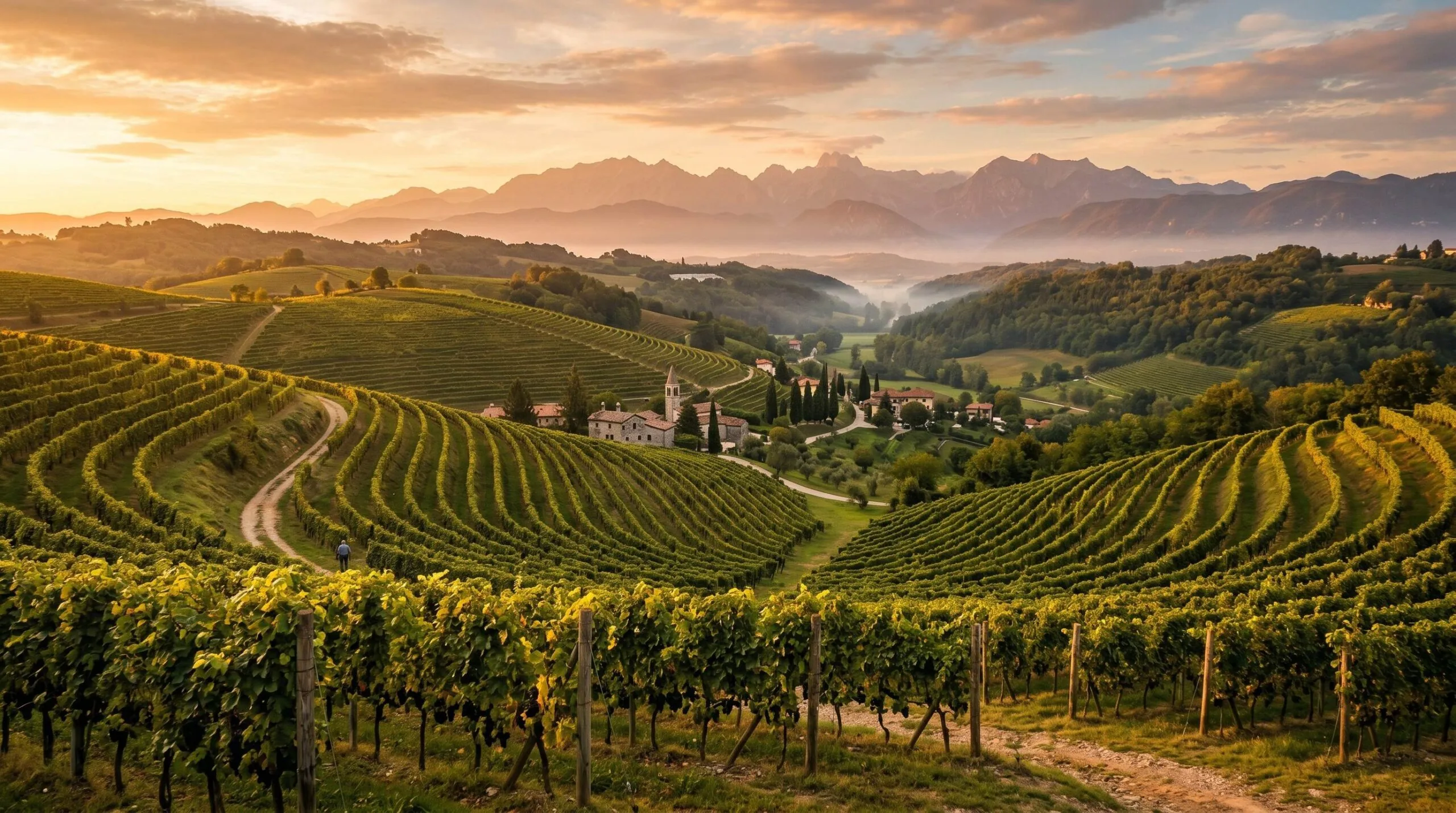
Travelling eastward, the landscape changes once again. The broad plains of Veneto gradually give way to rolling hills, the Adriatic Sea remains just beyond the horizon, and the Julian Alps begin to define the skyline.
This has always been a land of borders.
Here, Italy meets Central Europe and the Slavic world. Languages, cultures and traditions intertwine, and, as so often happens, wine becomes the most genuine reflection of that encounter.
Friuli Venezia Giulia has never sought to impress through power.
It chose a different path.
It chose precision.
Here, the protagonist is neither oak, nor concentration, nor the pursuit of intensity.
It is the grape itself.
Each variety is guided rather than transformed. Winemaking is designed to preserve its character, allowing the soil, the climate and time to tell their own story.
It is a philosophy that profoundly changed the way white wine is produced in Italy.
Today, Friuli Venezia Giulia is considered one of Italy’s greatest wine regions, not only for the quality of its wines, but for its extraordinary ability to express the relationship between grape variety and territory with remarkable clarity.
And it is the territory itself that reveals three distinct identities.
To the north-east lies Collio, stretching along the Slovenian border, where the rolling hills produce some of Europe’s finest white wines.
Further south, the Isonzo follows the river that gives it its name, where alluvial soils and the constant influence of the Adriatic create wines of remarkable elegance, brightness and precision.
To the east, the Colli Orientali del Friuli unfold across a succession of gentle hills where forests alternate with vineyards, and where some of Italy’s most important native varieties coexist alongside internationally renowned grapes.
Three territories.
Three different ways of interpreting wine.
One shared philosophy.
To let the land speak.
And perhaps this is Friuli Venezia Giulia’s greatest legacy.
The Renaissance of Italian White Wine
When Friuli changed the way white wine was made
For many years, Italian white wine was considered something to be enjoyed young. Fresh, pleasant and immediate. It was rarely associated with complexity, longevity or the ability to express a territory with the same depth as Italy’s great red wines.
Then, something changed.
It was here, in Friuli Venezia Giulia, between the 1960s and the 1980s, that this perception was rewritten.
A new generation of winemakers began looking at the vineyard differently. Yields were reduced, grape selection became more rigorous, and cellar techniques evolved rapidly. The introduction of temperature-controlled fermentation preserved freshness, precision and aromatic purity like never before.
Among the leading figures of this transformation were Mario Schiopetto, widely regarded as the father of modern Friulian white wine, and Livio Felluga, whose wines helped define the elegance and longevity of the region. A few years later, personalities such as Josko Gravner would push this research even further, rediscovering ancient winemaking practices and opening entirely new perspectives for contemporary white wine.
It was thanks to the vision of these producers that the transformation went far beyond technique.
The real revolution was cultural.
For the first time, Italian white wine ceased to be regarded simply as an alternative to red wine. It became a wine capable of ageing, evolving and expressing its territory with extraordinary elegance.
From that moment onward, Friuli Venezia Giulia became an international point of reference. Its wineries helped define a new language for Italian winemaking, profoundly influencing the production of white wines throughout the country.
Even today, it is impossible to speak about Italy’s greatest white wines without passing through these hills.
Because Friuli did not simply improve Italian white wine.
It changed the way we imagine it.
The Roots of Friuli
Identity preserved through native grapes
Every great wine region possesses its own language.
In Friuli Venezia Giulia, that language begins with its native grape varieties—grapes that have spent centuries adapting to a landscape shaped by hills, winds, mountains and the sea.
Among them all, Friulano has become the true symbol of the region. Elegant, restrained and remarkably refined, it combines freshness, structure and one of the most recognisable aromatic profiles in Italian wine.
Alongside it grows Ribolla Gialla, one of Friuli’s oldest grape varieties, now celebrated both in fresh, vibrant expressions and in more complex interpretations, including those produced through extended skin maceration.
Malvasia Istriana reveals the region’s more Mediterranean character, while Picolit stands among Italy’s finest meditation wines: naturally rare, delicate to produce and extraordinary in its elegance.
Alongside these native varieties thrive international grapes such as Sauvignon Blanc, Chardonnay, Pinot Grigio and Merlot, all of which have found some of their most refined Italian expressions in Friuli.
Yet an important distinction remains.
International varieties tell the story of Friuli’s ability to welcome and elevate grapes from beyond its borders.
Its native grapes tell the story of its memory.
They preserve the deepest connection with this land, shaped through generations of growers who came to understand their character, their limits and their extraordinary potential.
And perhaps it is within these roots that Friuli Venezia Giulia still finds its truest identity today.