


Where wine becomes rhythm
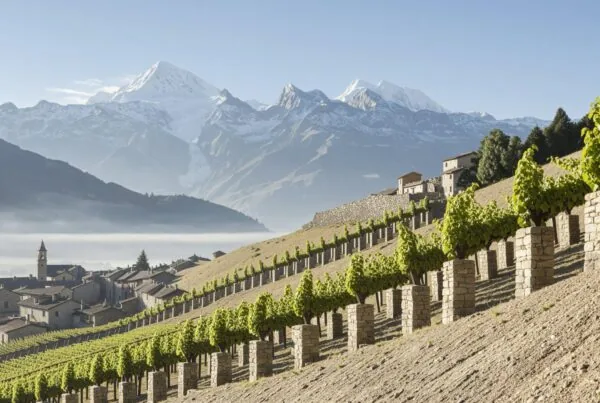
Moving toward the north-east, between the hills of Conegliano and Valdobbiadene, the landscape shifts once again.
The slopes soften, the vegetation opens, the light becomes more diffused. Here, wine leaves structure behind and moves in a different direction.
Proseccois made fromGleragrapes, grown on hills that balance precision and openness. Exposures vary, soils change, but what remains constant is the pursuit of freshness.
It is a wine that is not built through accumulation.
It is built through subtraction.
TheCharmat Method, used for the second fermentation, allows the preservation of the grape’s primary aromas. Fermentation takes place in pressurised stainless steel tanks, in shorter timeframes, keeping the wine direct and immediate.
In the glass,Proseccois dynamic. The perlage is light, continuous. Aromas are open and recognisable. The palate is smooth, designed to accompany.
It does not ask for concentration.
It asks for presence.
It is a wine that never stands still.
And for that reason, it has travelled the world.
The disciplinare and the hierarchy of the territory
Proseccois one of the most structured systems in Italy, often simplified but in reality highly precise.
At the base isProseccoDOC, produced across a wide area spanningVenetoand Friuli Venezia Giulia. It is the most widespread expression, the one that made Prosecco a global phenomenon.
Moving upward, we enter the hillside denominations.
Conegliano ValdobbiadeneProseccoSuperioreDOCGrepresents the historical and qualitative core of production. Here, slopes are steeper, vineyard work more demanding, and the result more precise.
Within this area, further levels emerge, such asCartizze, originating from a small, highly regarded zone.
The disciplinare does not simply define categories.
It defines a hierarchy of territory.
From plains to hills, from volume to precision.
Charmat Method
Freshness as a choice
TheCharmat Methodis not a shortcut. It is a choice.
Unlike theTraditional Method, the second fermentation takes place in pressurised stainless steel tanks. This allows the process to be controlled and relatively quick.
But the story begins earlier.
At the end of the 19th century, Federico Martinotti developed a system for carrying out the second fermentation in large closed containers, rather than in individual bottles. His goal was not to simplify wine, but to make the process more precise and consistent.
Years later, the method was refined and industrialised in France by Eugène Charmat, from whom it takes its more widely known name.
What remains, however, is the original intuition: controlling fermentation in order to preserve the character of the grape.
And this is exactly whatProseccorequires.
Proseccodoes not seek transformation through long contact with lees.
It seeks the purity of fruit.
Aromas remain direct: flowers, fresh fruit, light notes. The wine does not layer itself, it opens.
It is a method that works on immediate precision, not on long-term evolution.
And for this reason, it is perfectly aligned with the grape and the territory.
Wine as access
When simplicity becomes language
Proseccois often described as a simple wine.
In reality, it is an accessible wine.
The difference is essential.
It does not require preparation to be understood, but this does not mean it lacks technique. It is built to be immediately clear, without intermediate steps.
Its global success comes from this balance: ease and identity.
It does not impose a rhythm. It adapts.
And this is whereVenetocomes to a close.
Because ifValpolicellabuilds andAmaroneconcentrates,Proseccoopens.
And from this opening, the story can continue.