

Where the mountain shapes the wine
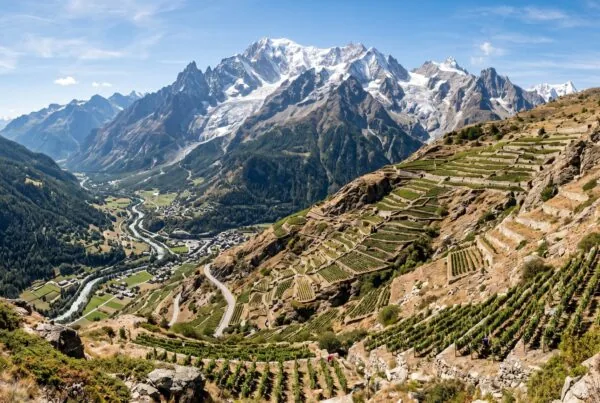
In the north of Lombardy, between the Rhaetian Alps and a line of light,Valtellinastretches from east to west following the course of the Adda River. It is a long, carved valley, south-facing, built to capture every possible ray of sunlight.
Here, the vine does not grow. It is earned.
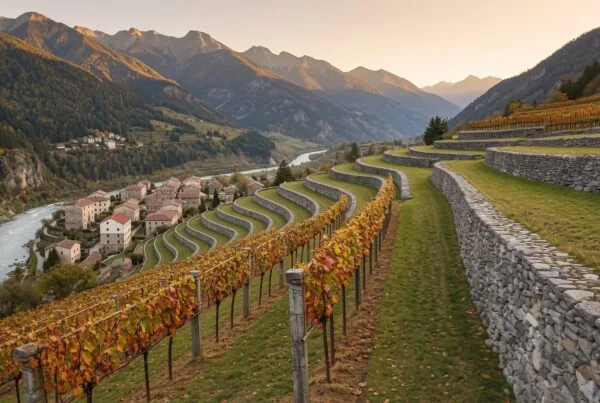
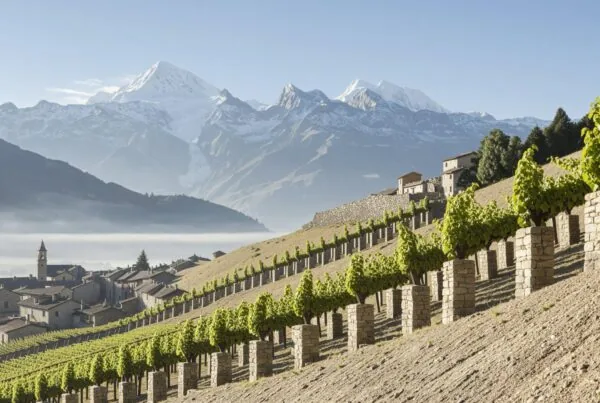
Vineyards climb along terraces supported by kilometres of dry stone walls. This is not a natural landscape, but a constructed one. Every stone is there to make viticulture possible in a place that would otherwise reject it.
The grape isNebbiolo, here known asChiavennasca. Its nature does not change, but its behaviour does.
The alpine climate slows everything down. Temperature swings are strong, ripening is long, often uncertain. The wine that emerges does not seek concentration. It works through tension.
In the glass,Valtellinais precision. The palate is vertical, sharp, continuous. It does not expand. It extends.
It is aNebbiolothat does not impose itself. It reveals itself.
The disciplinare and the geography of detail
Valtellina is not a single denomination, but a system.
ValtellinaSuperioreDOCGis divided into subzones that are not merely geographical indications, but true tools for reading the territory: Sassella, Grumello, Inferno, Valgella, Maroggia.
Each expresses a subtle but decisive variation. Exposure changes, altitude shifts, soil composition differs. The wine changes.
The disciplinare requires the almost exclusive use ofNebbiolo(Chiavennasca), with controlled yields and minimum ageing that allows the wine to stabilise without losing tension.
Here, precision does not come from standardisation.
It comes from difference.
Sfursat
When drying reshapes the wine
Alongside the verticality ofValtellinaSuperiore, there exists another expression, more concentrated, slower:Sfursat.
The grapes are harvested and left to dry for weeks, sometimes months, in ventilated environments. During this time, they lose water, concentrating sugars, aromas and structure.
This is not a forced process. It is a natural transformation, guided by air and time.
When the grapes are vinified, the result is a completely different wine. Broader, deeper, with a structure that expands rather than stretches.
And yet, even here, the mountain remains.
Sfursatnever becomes opulent in the way other dried-grape wines can. It maintains an internal tension, a freshness that keeps the wine in balance.
Drying does not serve to make the wine bigger.
It serves to change its direction.
Chiavennasca
Nebbiolo changing pace
InValtellina,Nebbiolodoes not change identity. It changes tempo.
The nameChiavennascadoes not indicate a different variety, but a closer relationship with the land. The vine adapts to more extreme conditions, slows down, refines itself, stretches.
The wine that results is lighter in colour, less broad in structure, but more precise in its trajectory.
Tannins are finer, acidity more pronounced, the finish longer than it is wide.
It is aNebbiolothat does not seek to occupy space.
It moves through it.
And for that reason, it remains.