

There are territories that produce wine, and territories that teach what it truly means to do so.Chianti Classicobelongs to the latter. It is not merely a denomination, but a landscape that has learned, over time, to recognize itself through wine. Rolling hills betweenFlorenceandSiena, forests breaking the vineyards, white roads following ancient paths. Here, the vine never dominates the land. It coexists with it.
The villages and the many expressions of place
Chianti Classico has never been uniform. Its heart beats through a constellation of historic villages that share a common identity while speaking different dialects of place.Greve in Chiantiopens northward with gentler exposures and a continuous dialogue between vineyard and forest.Panzanostretches between light and altitude, whereSangioveseoften finds natural tension.Radda, higher and cooler, forces slow ripening and yields wines of verticality and precision.GaioleandCastellinaexpress greater structure, shaped by poor soils and balance earned over time.
These places are not mere names on a map. They are interpretations of the same landscape. For centuries, growers recognized these differences without formal definitions. They spoke of hills, exposures, winds. The wine changed, even when the name remained the same.
UGAs and the renewed reading of the territory
In recent years, Chianti Classico has given form to this awareness through theUnità Geografiche Aggiuntive. TheUGAsdo not create hierarchy. They offer depth. They clarify rather than divide, acknowledging that within a historic denomination there exist distinct, coherent identities.
This renewed reading of place is the result of long observation and study. In this context, the work ofAlessandro Masnaghettihas been fundamental. His guide toChianti Classicois now considered a technical reference, mapping the UGAs with precision and offering a way to understand the territory before tasting the wine.
Production rules and stylistic identity
This focus on place is reflected in the production rules.Sangioveseis central and must account for at least eighty percent of the blend, often reaching one hundred percent. Complementary grapes are limited to traditional Tuscan varieties such asCanaiolo, Colorino, and Malvasia Nera. Yields are controlled, aging periods are mandatory, and oak is used to accompany rather than transform.
Chianti Classico does not seek effect. It grows with time. It has tension, depth, and a freshness that supports rather than overwhelms. It does not ask to be understood immediately, but to be followed, like the landscape from which it comes.
To understand Chianti Classico in the broader context of Tuscan wine, explore ourcomplete guide to Tuscan wine regionsand appellations. From the Black Rooster and the hills between Florence and Siena to Sangiovese, UGAs and the contrast with Brunello, Vino Nobile and Bolgheri, the article explains why Chianti Classico remains one of Tuscany’s most important wine territories.
The Black Rooster: a legend that draws a boundary
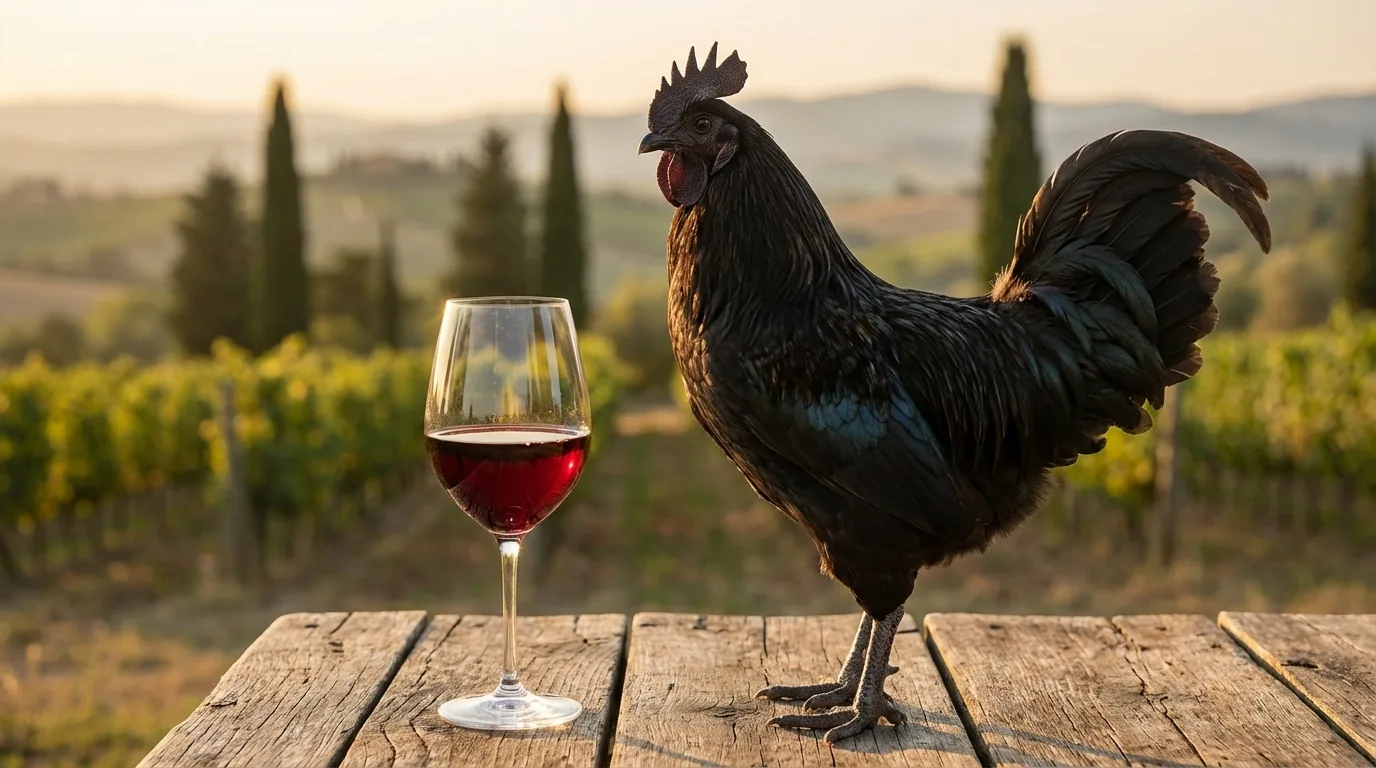
Every great wine territory carries a symbol. InChianti Classico, that symbol is theBlack Rooster. Its origin belongs not to documented history, but to legend, to stories created to give shape to identity.
It is said that in theMiddle Ages, whenFlorenceandSienawere rivals, the two cities agreed to settle border disputes with a symbolic challenge. Two riders would depart at dawn, one from Florence and one from Siena, riding toward each other. The meeting point would define the boundary. Their departure would be announced by the crowing of a rooster.
Florence chose a black rooster. Siena chose a white one. From here, the legend takes on color. The Florentine black rooster was kept in darkness and without food, so it would crow as early as possible, driven by hunger and restlessness. The Sienese white rooster, well fed and cared for, crowed only when the sky was already beginning to lighten.
The Florentine rider departed much earlier and rode for hours, meeting the Sienese nearCastellina in Chianti. According to the tale, the land beyond that point was assigned to Florence, and the black rooster became the symbol of those hills and the wine born from them.
Whether true or not, the story endures because it captures something essential. The idea that the boundary ofChianti Classicois not merely a line on a map, but the product of history, imagination, and shared identity. TheBlack Roosteris not just an emblem, but a narrated memory, reminding us how deeply wine and place are intertwined in these hills.
Chianti: a broader constellation, many voices
Beyond the historic core ofChianti Classicolies a wider territory that carries the same name while telling a different story.Chianti, without the wordClassico, is a broad macro-area spanning much of central Tuscany, encompassing diverse climates, elevations, and soils.
Here, wine arises from a more open geography. Hills widen, temperatures rise, and maritime or inland influences alter ripening rhythms. The result is a plural denomination capable of producing wines that are more immediate, softer, or sunnier, depending on the area.
The regulations reflect this breadth. InChianti,Sangiovesemust represent at least seventy percent of the blend, while the remaining thirty percent may include traditional local varieties or, in some cases, authorized international grapes. Permitted yields are higher and aging requirements are less restrictive.
Historically,Chiantihas been the wine of everyday life, tied to the table and rural rhythm. A wine meant to accompany and to be shared. Today it is a living denomination, evolving while remaining connected to its roots.
Chianti ClassicoandChiantiare not in competition. They are two scales of the same landscape. One speaks in detail, the other in breadth. The voice changes, not the intention.