
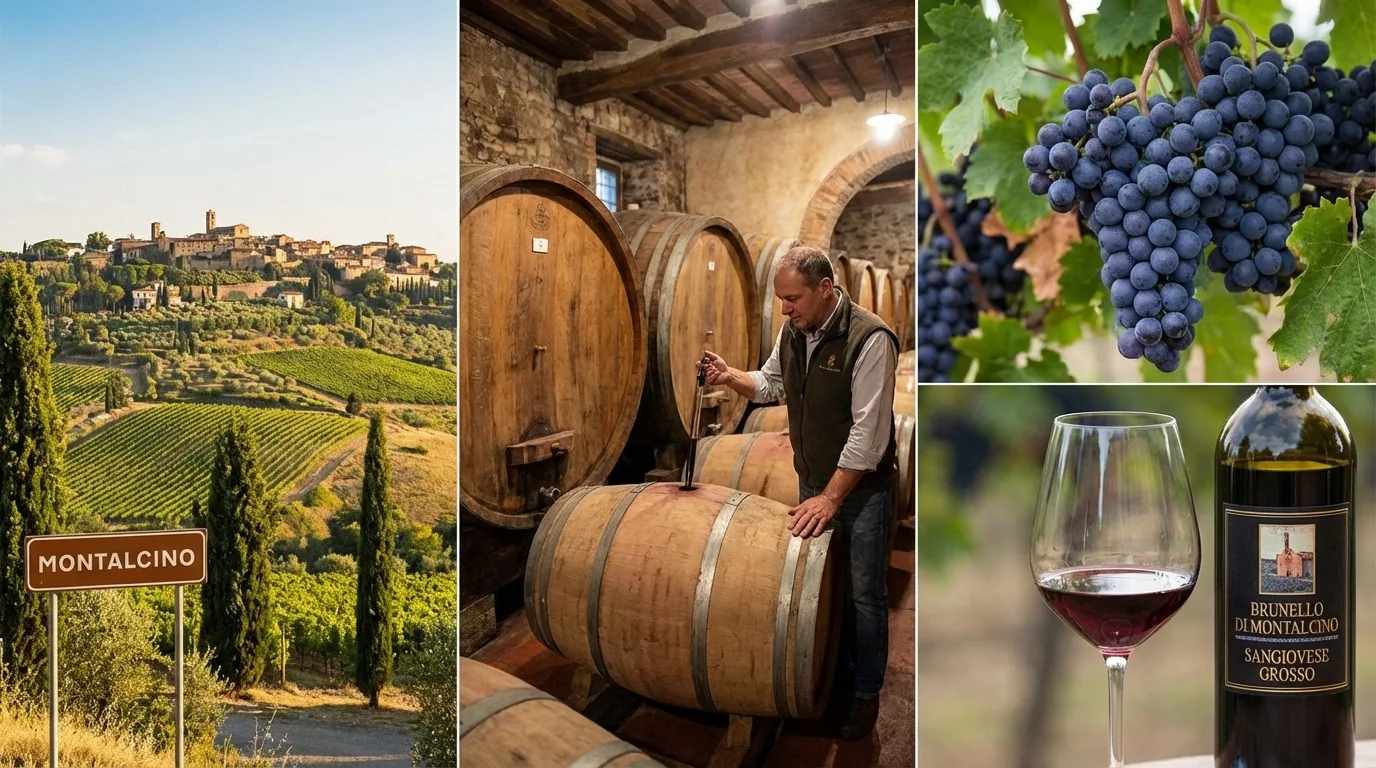

As one travels south through Tuscany, leaving behind its most familiar heartlands, the landscape slowly changes pace. The hills grow broader, the light sharper, the air drier and clearer. It is here, in thesoutheasternpart of the province of Siena, that Montalcino rises as a solitary hill, surrounded by the Val d’Orcia and naturally enclosed by rivers and ridges that almost turn it into a land island. The sea is not visible, yet it is not far. The Tyrrhenian coast lies just over one hundred kilometers away as the crow flies, and its influence reaches Montalcino throughdry breezesthat help keep the environment healthy and well ventilated.
Montalcino is not a uniform territory. It is amosaic of altitudes, exposures and soilsthat can change dramatically within short distances. Lower vineyards seek warmth and full ripeness, while higher sites work with slowness, freshness and tension. Nearby,Mount Amiata acts as a silent regulator, protecting the area from sudden climatic extremes. All of this contributes to an equilibrium that is never guaranteed, but always carefully negotiated.
The appellation of Montalcino corresponds exactly to the municipal boundaries. Not a province, not an extended zone, butone single commune entirely recognized as the place of origin. This choice reveals much about the character of the territory, which has preferred precise definition over expansion. Wine here is born froma direct relationship with place, not from an abstract idea of style.
Human work reflects this coherence. Producers in Montalcino do not pursue a single model. Historic families coexist with newer generations, classical interpretations with more contemporary readings. Hands change, sensibilities evolve, yet one principle remains constant:the land is never forced. It is listened to.
This is why Montalcino, together with Brunello, has become one of Tuscany’s great symbols in the world. Not only because of wine quality, but because ofa clear idea of time, balance and responsibility. Wine here is not made to impress.It is made to endure.
For more background on Brunello di Montalcino and its place among Tuscany’s great wines, visitour guide to Tuscan wine, regions and grape varieties. The article connects Montalcino with Chianti Classico, Vino Nobile di Montepulciano and Bolgheri, helping readers understand how Sangiovese, terroir, aging rules and regional identity define Tuscan wine.
Brunello di Montalcino: The Production Code as an Act of Respect
Brunello di Montalcino is not a wine in a hurry. It is a wine that takes the time it needs to become itself. This sense of time is not romantic suggestion. It iswritten into the production regulations, carved into agricultural decisions and measured with precision.
The foundation is clear. Brunello di Montalcino is produced exclusively fromSangiovese grapes, but in Montalcino this name takes on a more specific meaning. Historically and ampelographically, the grape used is what is commonly known asSangiovese Grosso, also traditionally called Brunello. This local biotype has demonstrated herean extraordinary ability to sustain long agingwithout losing its identity.
The production rules begin in the vineyard, throughyield control. For Brunello di Montalcino, the maximum permitted yield is eight tons of grapes per hectare, with a maximum grape-to-wine yield of sixty-eight percent. These figures are not meant to impress, but to remind us of something essential:concentration is not created in the cellar, it is decided among the vines.Producing less means asking more of the plant, and accepting greater risk year after year.
Then comes time, the long kind. Brunello may not be released beforethe first day of January of the fifth year following the harvest. Riserva waits even longer,a total of six years. In both cases, at least twenty-four months must be spent in oak. The regulations specify oak barrels, but do not dictate size or style.This is where the producer steps in.
Large casks, tonneaux or barriques are not aesthetic choices, butinterpretative tools. Wood must not dominate, but accompany. It must support structure without erasing the voice of the land. This is why two Brunellos can be profoundly different while fully respecting the same rules.The regulations define the perimeter. Within it lives human intelligence.
After wood aging, the wine must undergo a mandatory period of bottle aging. It is a silent phase, yet a decisive one. Here the wine recomposes itself, finding balance between what the vineyard has given and what time has shaped.
The difference between Brunello and Brunello Riserva is not merely a matter of additional months. It isa difference in vision. The standard Brunello expresses the character of the vintage more directly. Riserva is born from stricter selection, conceived from the outset to travel further through time. It is not automatically better.It is simply another idea of duration.
This is why Brunello di Montalcino has become a global reference. Not because it is powerful, but because it knows how totransform power into depth. Because it shows that greatness in wine comes fromthe ability to wait.
The Biotypes of Sangiovese: One Grape, Many Interpretations
When speaking of Sangiovese, it is essential to clarify that we are not dealing with a single, fixed form. Sangiovese is a grape variety that has developed different biotypes over time, shaped by the places in which it has been cultivated. These are not value rankings, butdistinct expressionsof how the same grape has learned to dialogue with different environments.
In Tuscany, some of the most historically significant biotypes can be found. In Montalcino,Sangiovese Grosso, traditionally known as Brunello, shows broad structure, firm tannins and a natural predisposition for long aging. It is a biotype that works withtime and transformation.
Elsewhere in Tuscany, particularly in the Chianti areas,Sangiovese Piccolo, often referred to as Sangioveto, is widely planted. Here the grape expresses greater agility, freshness and immediacy, while retaining strong territorial identity and remarkable gastronomic versatility.
In Montepulciano,Prugnolo Gentilerepresents another expression closely related to the Sangiovese Grosso lineage, shaped by specific soils and elevations that lend the wines a different texture, often softer and more measured.
Moving south toward the Maremma, Sangiovese takes the nameMorellino. In this warmer, maritime-influenced environment, the grape adopts a more Mediterranean profile, often more generous and approachable, while still maintaining structure and character.
Outside Tuscany, in Romagna, Sangiovese has historically been cultivated in a more extensive manner. The local biotype has long prioritized quantity and everyday drinkability, resulting in more direct, less concentrated wines. In recent years, noteworthy qualitative efforts have emerged, yet the cultural approach remains distinct fromthe Tuscan pursuit of longevity and depth.
These biotypes do not describe a hierarchy, buta geography. They help us understand how the same grape can change its voice without losing its identity. And it is precisely this capacity for adaptation that makes Sangioveseone of the most compelling pillars of Italian wine.